Dating women, men compose songs or novels in the name of great love to them. Almost all men give their wives and brides jewels. But there are also those who build buildings in the name of love. Let us present you the monuments of architecture that were created for women.

When people fall in love, they write songs, poems, and novels. Some give flowers or jewelry. Others try to make feeling permanent in stone, marble, and landscape. Across centuries, rulers, artists, and patrons have commissioned buildings and gardens to honor women they loved, mourned, or idealized. Here are five famous examples, ranging from ancient legend to modern history.
When Architecture Becomes a Declaration of Love
Not every story on this list is equally well documented. Some, like the Taj Mahal, are supported by a rich historical record. Others, like the Hanging Gardens of Babylon, survive partly through legend. Yet together they reveal the same impulse: to turn affection, grief, admiration, or longing into architecture that can outlive a human life.
Hanging Gardens of Babylon
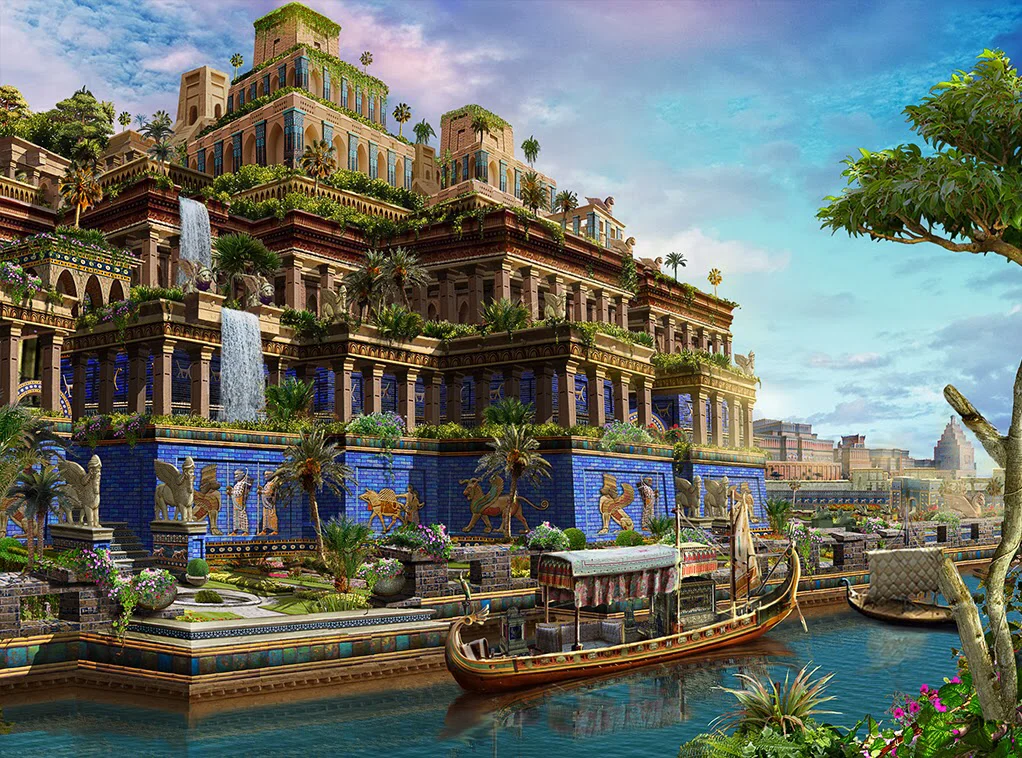
According to ancient tradition, the earliest great architectural monument of love was created in the 6th century BC. Babylonian king Nebuchadnezzar II, who reigned from about 605 to 562 BC, is said to have ordered the gardens for his Median wife Amitis, who missed the green mountains and cooler landscapes of her homeland. Later descriptions imagine a spectacular series of elevated terraces planted with trees, shrubs, and flowers, supported by masonry platforms and fed by an advanced irrigation system.
The Hanging Gardens became famous as one of the Seven Wonders of the Ancient World. At the same time, modern historians still debate whether they truly stood in Babylon, whether they were confused with another royal garden in Nineveh, or whether the story was enlarged by later retellings. That uncertainty only adds to their power: they remain one of history's most evocative examples of love translated into landscape and architecture.

Taj Mahal
The Taj Mahal is perhaps the most famous monument of love in the world. Standing on the right bank of the Yamuna River in Agra, India, it was commissioned by Mughal emperor Shah Jahan after the death of his beloved wife Mumtaz Mahal in 1631. Construction of the main mausoleum was completed in 1648, while the wider complex, including the mosque, guest house, forecourt, and gates, was completed around 1653.
Mumtaz Mahal, whose name is usually translated as "Chosen One of the Palace," was Shah Jahan's closest companion and trusted adviser. She died while giving birth to their 14th child. The emperor answered that loss with an immense architectural project: a white marble mausoleum set within a formal charbagh garden and enriched with calligraphy, stone inlay, and extraordinary geometric symmetry. Covering roughly 17 hectares, the Taj Mahal remains one of the finest achievements of Mughal architecture as well as one of the clearest examples of grief transformed into beauty.

Neuschwanstein Castle
Neuschwanstein Castle is often described as one of the most romantic buildings in Europe, although its story is more complex than a simple tribute to a beloved woman. Begun in 1869 for Ludwig II, King of Bavaria, the castle was conceived primarily as a private fantasy retreat and as an architectural homage to the medieval world and the works of Richard Wagner. Ludwig died in 1886 before the palace was completed, and only a small part of the grand design was ever finished.
Even so, Neuschwanstein belongs in any discussion of architecture and love because it embodies idealized, almost theatrical romance. Its towers, murals, and interiors were shaped by medieval legends such as Lohengrin and Tannhäuser, transforming personal longing into built form. The castle later became one of the most recognizable images of romantic historicism in the world, and in 2025 it was included, together with other palaces of Ludwig II, on the UNESCO World Heritage List.

Bory Castle
All the previous monuments were associated with rulers or very wealthy patrons. Bory Castle tells a more personal story. Hungarian architect and sculptor Jenő Bory began building it in 1923 in Székesfehérvár and continued working on it for decades, largely with his own hands and with help from a few students. He dedicated the castle to his wife, the painter Ilona Komócsin, making it a monument not only to love, but also to a shared artistic life.
The structure combines romantic historicism with highly individual fantasy. Rising about 30 meters high, it includes seven towers and around 30 rooms, and it is filled with sculptures, paintings, and symbolic spaces connected with devotion and marriage. Because Bory kept developing it until his death in 1959, the castle feels less like a single project and more like a lifelong diary in stone, concrete, and art.
Sklifosovsky Hospital
In Moscow, the building now associated with the Sklifosovsky Institute for Emergency Medicine is also linked to one of the most unusual love stories in Russian aristocratic history. Count Nikolai Sheremetev fell in love with Praskovya Kovalyova-Zhemchugova, a gifted serf actress and singer from his private theater. Against the conventions of the time, he obtained permission to marry her, turning what many considered an impossible relationship into a real union.

The marriage was brief. Praskovya died in 1803 not long after giving birth to their son. In her memory, Sheremetev financed a hospice house for the poor in Moscow, a charitable institution designed with the dignity and scale of a palace rather than a purely utilitarian hospital. The complex opened in 1810 and later became part of what is now the Sklifosovsky Institute, leaving behind a rare example of private grief transformed into public care and architectural legacy.