Explore the creative DNA of painting styles, from Renaissance perspective to Pop Art and abstraction. A visual guide to art movements, artistic techniques, and creative ways of seeing.
Painting is often described as a history of images, but it is more useful to see it as a history of creative decisions. Every major painting style answers a different question: how should space be organized, how should light behave, how should the body be represented, how should emotion appear, and how much should a painting resemble the visible world?
This creative infographic series explores painting styles not as decorative labels, but as visual systems. Renaissance painting, Baroque drama, Impressionist light, Cubist fragmentation, Surrealist dream logic, Abstract Expressionist gesture, and Pop Art's commercial imagery each reveal a different way of seeing. Together, they form a visual atlas of creativity.
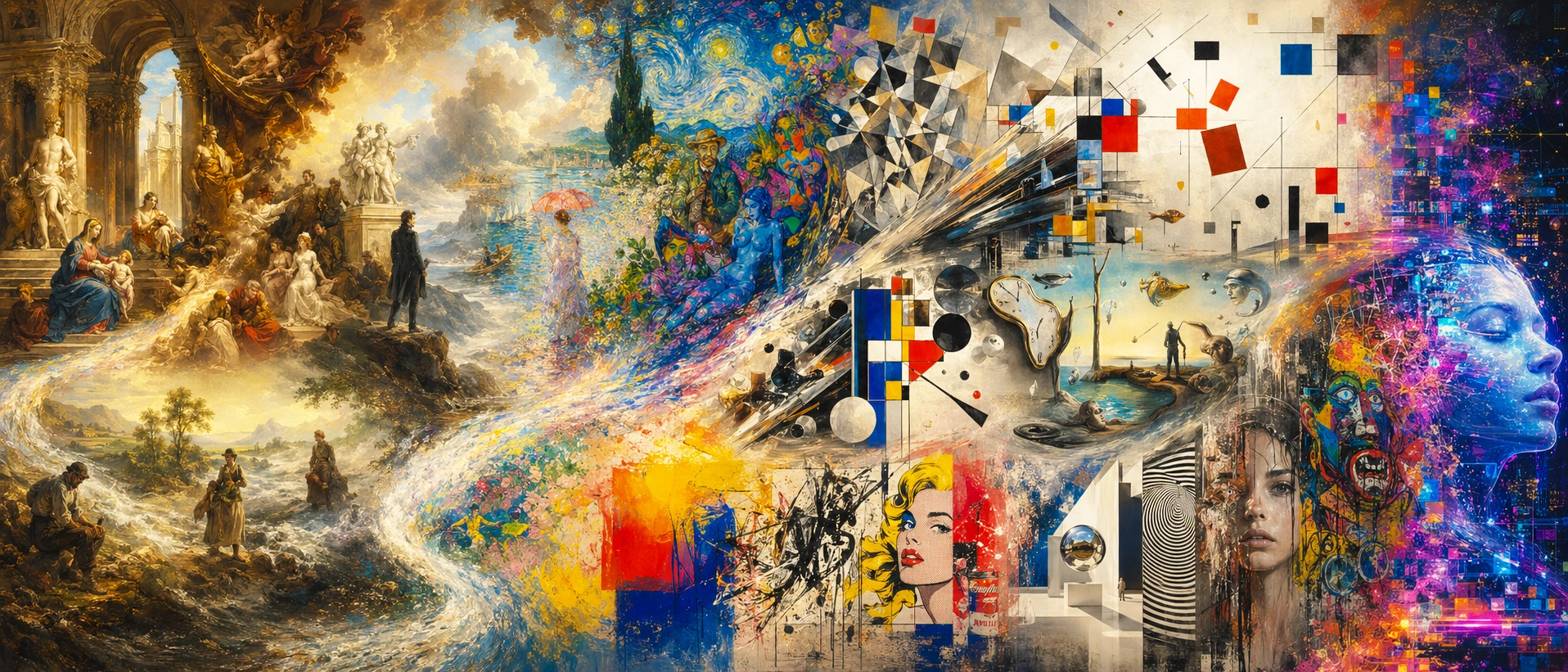
The goal is simple: to help viewers recognize art styles by their visual DNA.
Instead of memorizing dates and names, this series looks at the deeper structure behind each movement: color, composition, brushwork, space, subject matter, philosophy, and historical pressure. Once these elements become visible, painting becomes easier to read. A work of art stops being only beautiful or famous. It becomes a record of how artists solved creative problems.
Why Painting Styles Matter
A painting style is more than an aesthetic. It is a method of thinking.
The Renaissance was not simply "more realistic" than Gothic painting. It was a creative system for ordering space, the body, and the viewer's gaze. Baroque painting was not just dramatic. It transformed light into theater. Impressionism was not unfinished painting. It was a radical attempt to capture perception before it hardened into detail. Cubism was not distorted anatomy. It was an attack on the idea that reality must be seen from one fixed point.
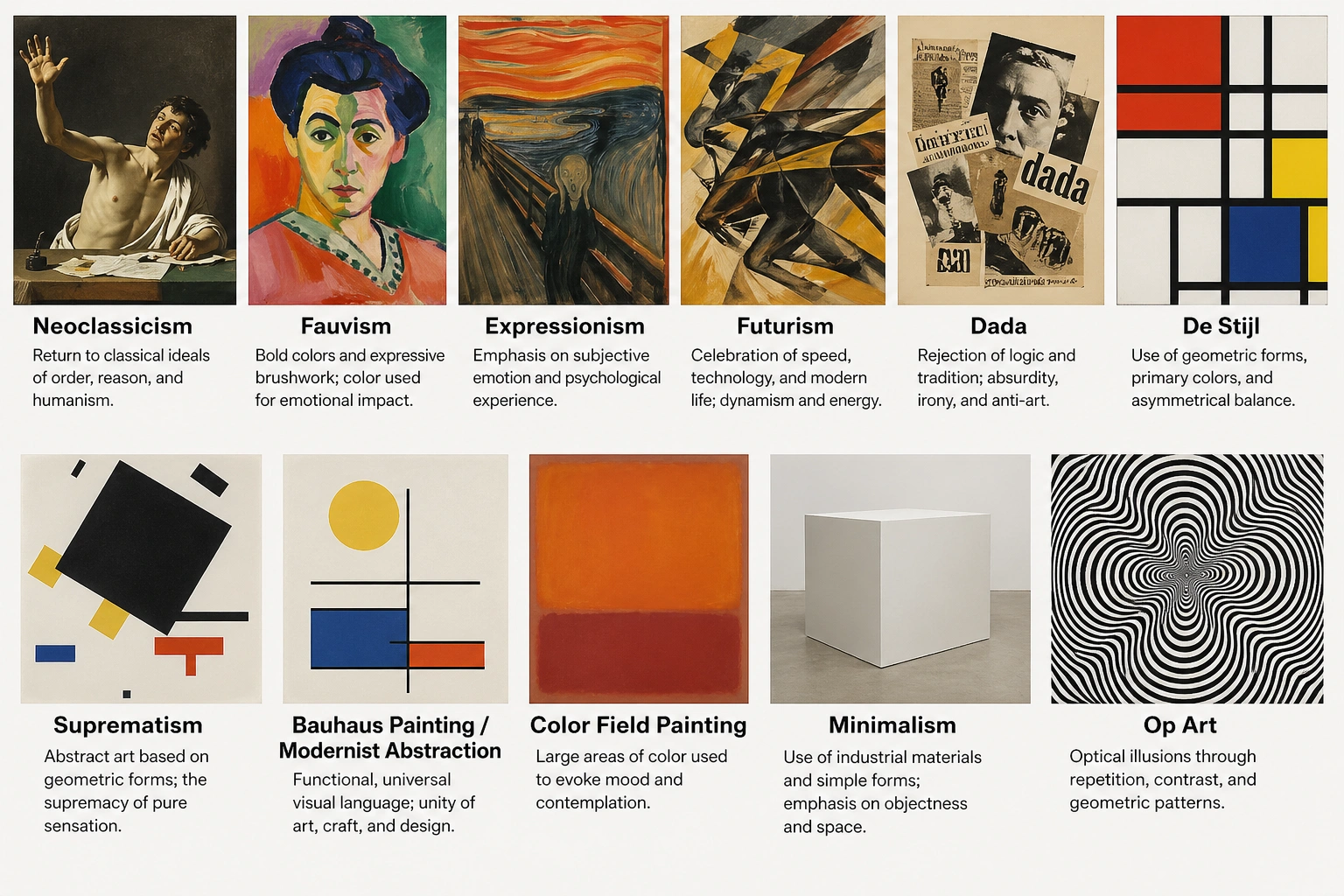
Every art movement changes the rules of vision.
That is why painting styles remain powerful for artists, designers, filmmakers, architects, photographers, and creative directors today. The same visual languages that shaped museums also shape posters, fashion campaigns, video games, interiors, films, album covers, and AI-generated imagery.
To study painting styles is to study creative possibility.
The Creative DNA of a Painting Style
Each infographic in this series is built around the idea of visual DNA. Instead of treating an art movement as a historical footnote, the series breaks it into recognizable traits.
A painting style can be read through several creative dimensions:
1. Space
Does the painting feel flat, deep, compressed, infinite, unstable, or theatrical?
Renaissance painters used linear perspective to create rational depth. Byzantine and Gothic artists often emphasized symbolic flatness. Cubists fractured space into multiple viewpoints. Abstract painters sometimes removed recognizable space altogether.
2. Light
Is the light natural, symbolic, dramatic, optical, artificial, or emotional?
Baroque artists used strong contrasts of light and shadow to create tension. Impressionists studied changing outdoor light. Surrealists often used clear, realistic light to make impossible scenes feel strangely believable.
3. Color
Does color describe reality, intensify emotion, create harmony, or disrupt expectation?
Fauvism used color as creative force rather than natural description. Pop Art borrowed the boldness of advertising and mass production. Renaissance painting often pursued controlled tonal harmony.
4. Brushwork
Are brushstrokes hidden, visible, broken, expressive, aggressive, or mechanical?
Academic and Renaissance painting often smoothed the surface. Impressionism made brushwork visible. Abstract Expressionism turned the brushstroke into the event itself.
5. Composition
Is the image balanced, chaotic, diagonal, symmetrical, fragmented, or monumental?
High Renaissance composition often feels stable and harmonious. Baroque painting favors diagonals, movement, and theatrical staging. Minimal painting reduces composition to spare relationships of form, color, and surface.
6. Subject
What does the painting believe is worth showing?
Religious icons, mythological heroes, civic leaders, workers, landscapes, dreams, advertisements, bodies, gestures, machines, and ordinary objects all reveal what a culture finds meaningful.
7. Worldview
Every style carries an assumption about reality.
Renaissance painting suggests the world can be measured. Romanticism suggests the world overwhelms reason. Surrealism suggests the unconscious is as real as waking life. Pop Art suggests that modern reality is already mediated by images.
This is what makes the series valuable: it treats painting styles as creative intelligence, not just visual appearance.
The Renaissance
The opening infographic focuses on the Renaissance because it marks one of the most influential creative shifts in Western painting.
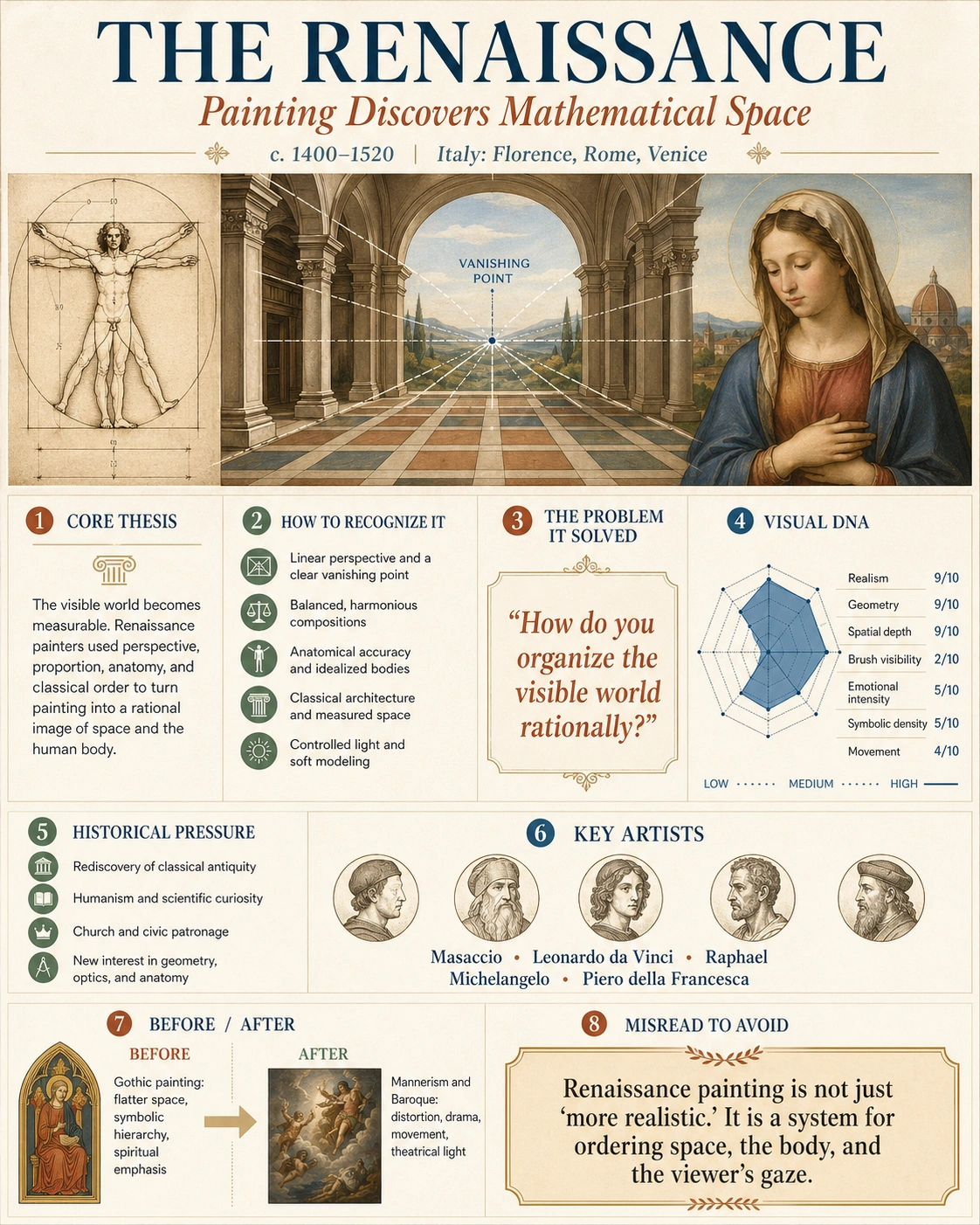
Its central thesis is:
The visible world becomes measurable.
Renaissance artists used perspective, proportion, anatomy, geometry, and classical architecture to build paintings that felt rational, ordered, and human-centered. The picture plane became a window into organized space.
A Renaissance painting is often recognizable through linear perspective, a clear vanishing point, balanced composition, anatomical accuracy, classical architecture, controlled light, and soft modeling.
The key creative problem of Renaissance painting was:
How do you organize the visible world rationally?
That question changed the history of visual art. It shaped not only painting, but architecture, drawing, scientific illustration, stage design, urban planning, photography, cinema, and digital world-building. The Renaissance infographic begins the series by showing painting as a creative system for organizing reality.
From Renaissance Order to Baroque Drama
Once painting learned to organize space, later movements began to challenge that order.
Baroque painting intensified the emotional charge of the image. It pushed composition toward drama, movement, darkness, theatrical light, and psychological urgency. Where the Renaissance often feels balanced, Baroque painting often feels unstable, immediate, and alive.
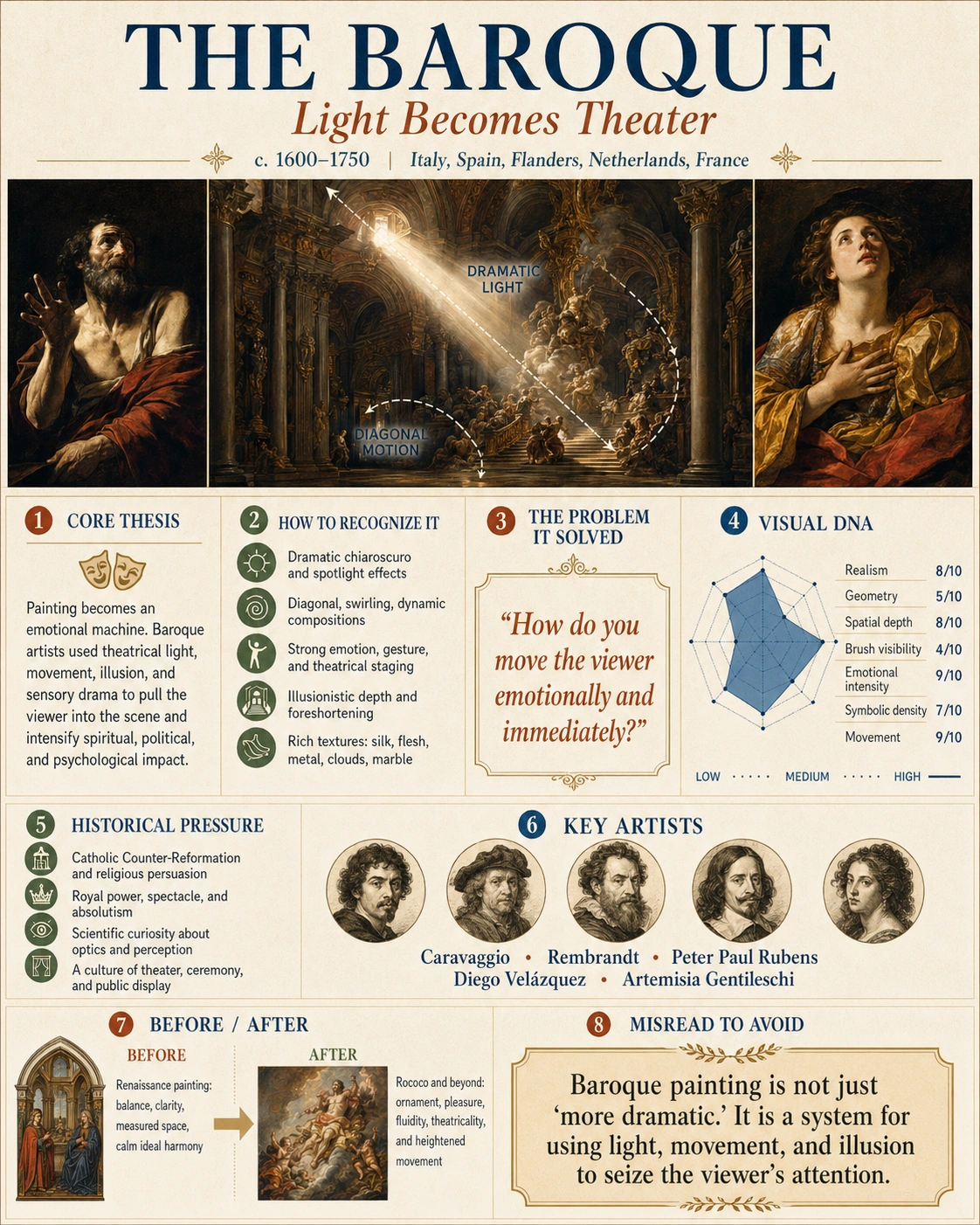
Its central thesis is:
Light becomes theater.
The key creative problem of Baroque painting was:
How do you move the viewer emotionally and immediately?
Baroque painting is recognizable through dramatic chiaroscuro, diagonal movement, theatrical staging, illusionistic depth, emotional gestures, and richly textured surfaces. It turns painting into an immersive event, pulling the viewer into the scene rather than asking them to observe from a calm distance.
The Renaissance asks for order.
The Baroque asks for impact.
This contrast is essential to the series because creativity often advances through opposition. One style establishes a visual grammar. Another style bends, exaggerates, or explodes it.
Rococo and the Creative Theater of Pleasure
After the grandeur and religious intensity of Baroque painting, Rococo turned painting toward intimacy, ornament, leisure, and aristocratic fantasy.
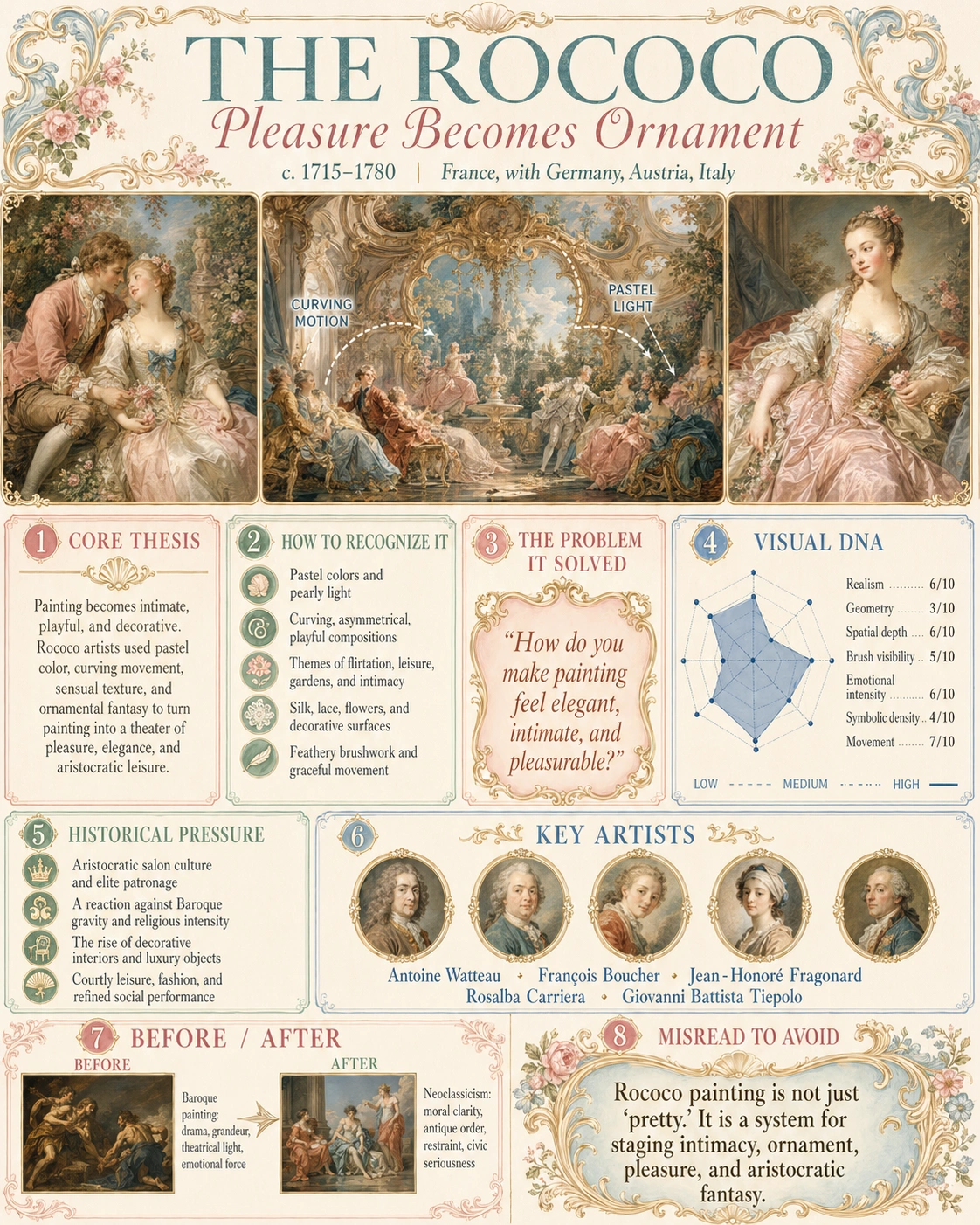
Its central thesis is:
Pleasure becomes ornament.
Rococo painting is recognizable through pastel color, pearly light, curving compositions, decorative surfaces, flirtatious subjects, gardens, silk, lace, flowers, and a sense of graceful theatricality. It makes painting feel elegant, intimate, and pleasurable.
The key creative problem of Rococo painting was:
How do you make painting feel elegant, intimate, and pleasurable?
Rococo is not simply "pretty" painting. It is a creative system for staging intimacy, ornament, sensuality, and social performance. It shows how painting can become an atmosphere of refinement, fantasy, and decorative intelligence.
Neoclassicism and the Return of Moral Form
Neoclassicism reacted against Rococo pleasure by returning to antique order, restraint, clarity, and civic seriousness.
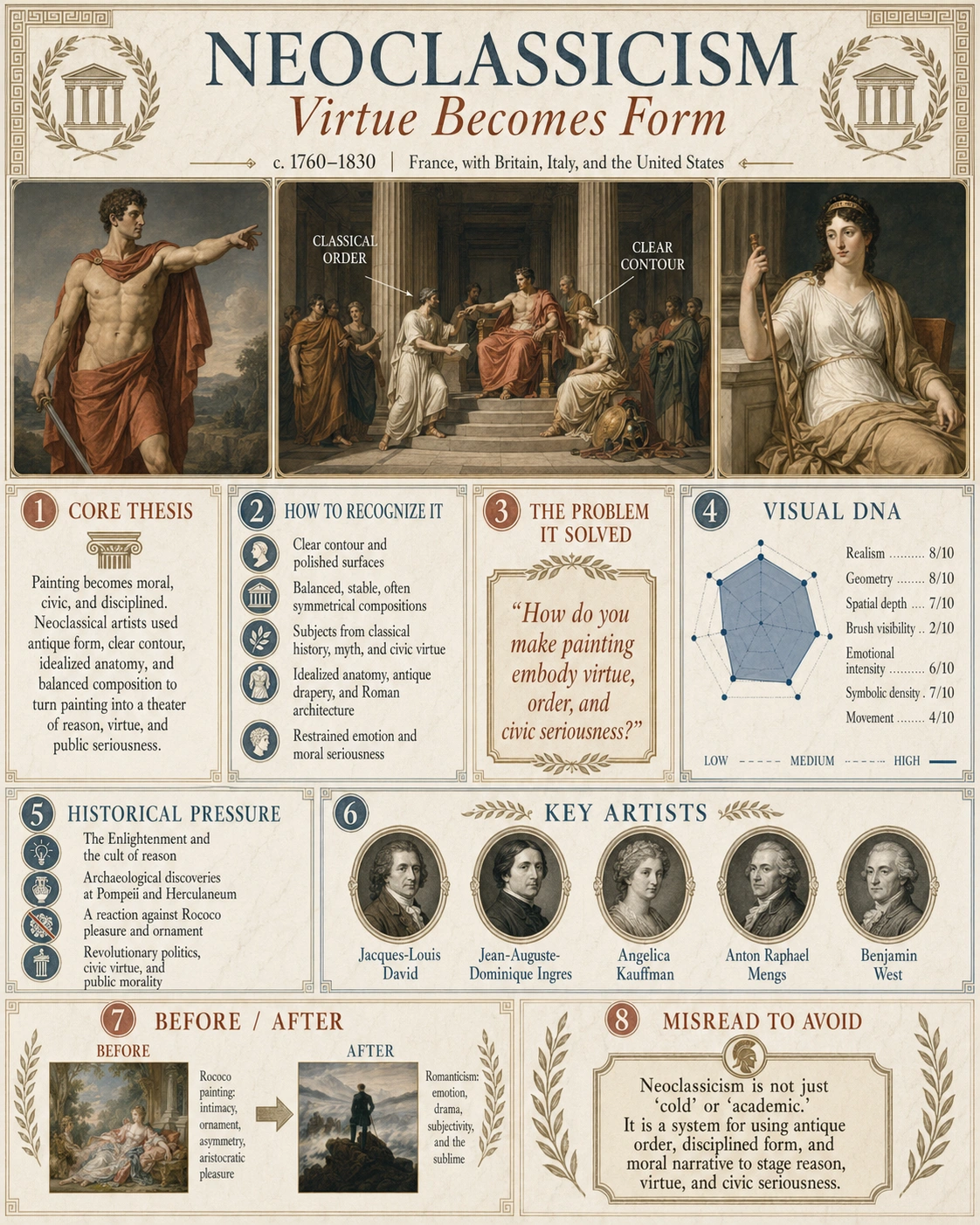
Its central thesis is:
Virtue becomes form.
Neoclassical painting is recognizable through clear contours, polished surfaces, balanced compositions, classical subjects, antique drapery, restrained emotion, and architectural order. It treats painting as a theater of reason, discipline, and moral seriousness.
The key creative problem of Neoclassicism was:
How do you make painting embody virtue, order, and civic seriousness?
This movement shows how creative style can become ideological structure. Neoclassicism does not only borrow from Greece and Rome. It uses classical form to communicate public morality, rationality, sacrifice, and political seriousness.
Romanticism and the Sublime Imagination
Romanticism pushed against Neoclassical restraint by turning toward emotion, imagination, nature, terror, longing, and the sublime.
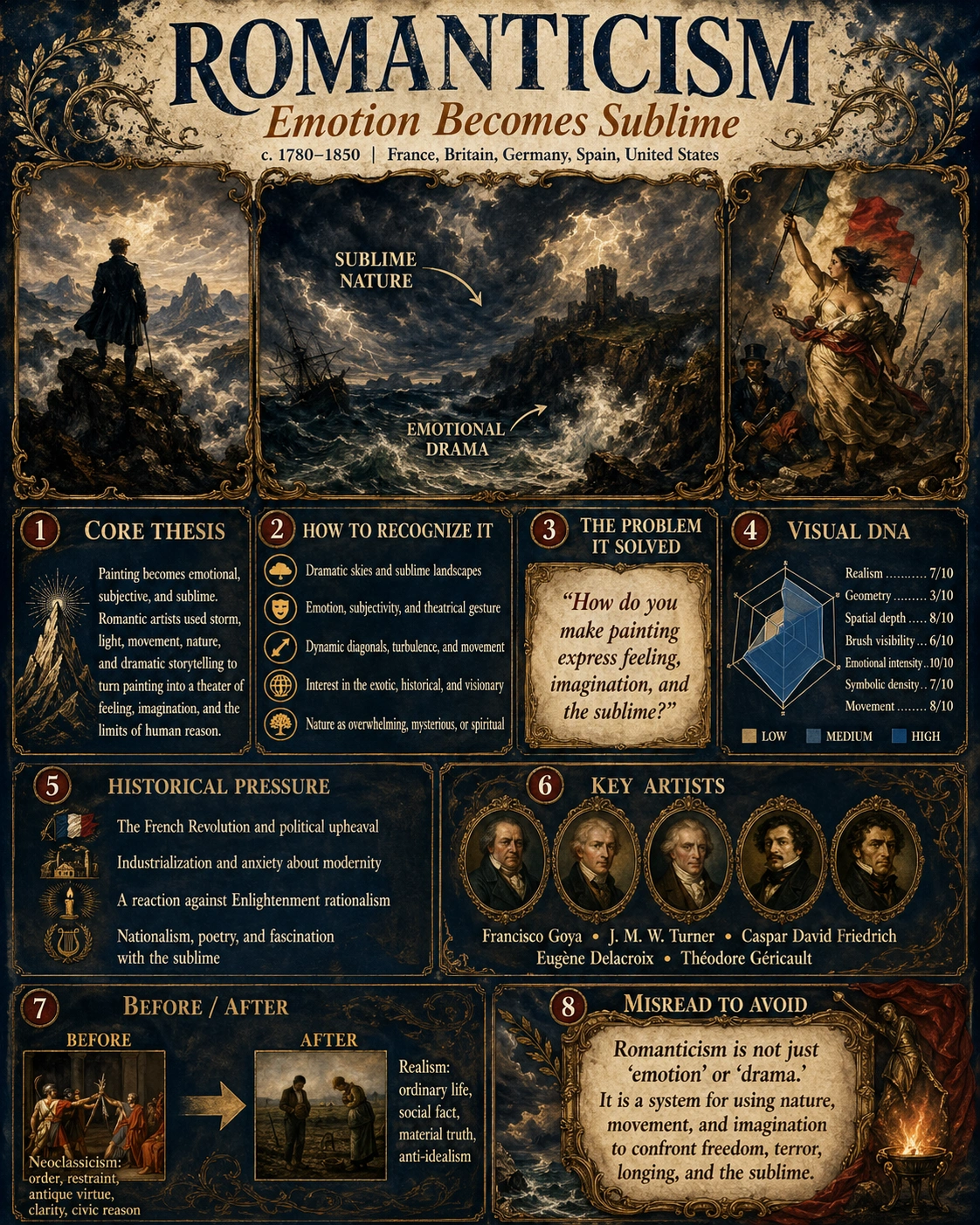
Its central thesis is:
Emotion becomes sublime.
Romantic painting is recognizable through stormy skies, dramatic landscapes, turbulent movement, theatrical gesture, heroic or isolated figures, historical drama, exotic subjects, and overwhelming nature.
The key creative problem of Romanticism was:
How do you make painting express feeling, imagination, and the sublime?
Romanticism is not merely dramatic. It is a creative system for confronting freedom, terror, desire, spiritual intensity, political upheaval, and the limits of human reason. It makes painting a stage for the inner life.
Realism and the Dignity of Ordinary Life
After Romanticism's storms and heroic intensity, Realism brought painting back to material life.
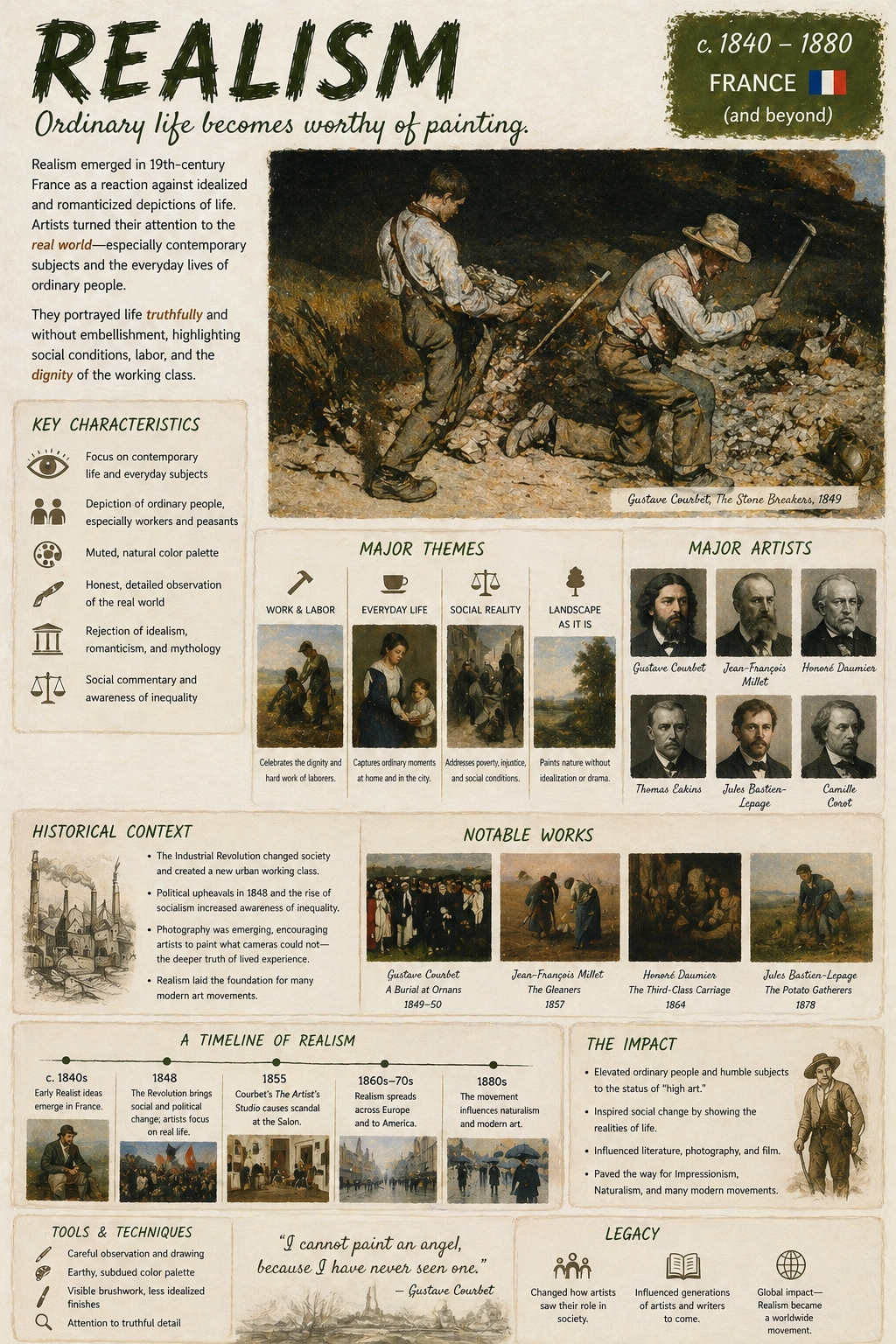
Its central thesis is:
Ordinary life becomes worthy of painting.
Realist artists turned away from myth, ideal beauty, heroic fiction, and theatrical drama. They painted workers, peasants, streets, labor, class conditions, and the visible facts of contemporary life.
The key creative problem of Realism was:
How do you make ordinary life historically important?
Realism is recognizable through ordinary people, everyday subjects, unidealized faces and bodies, earthy palettes, natural light, believable space, and a serious unsentimental tone.
Its creative importance is enormous. Realism expands the subject of painting. It says that labor, poverty, social class, domestic life, and public reality are not secondary subjects. They are central to modern visual culture.
Impressionism and the Creative Power of Perception
Impressionism changed painting by treating vision as unstable.
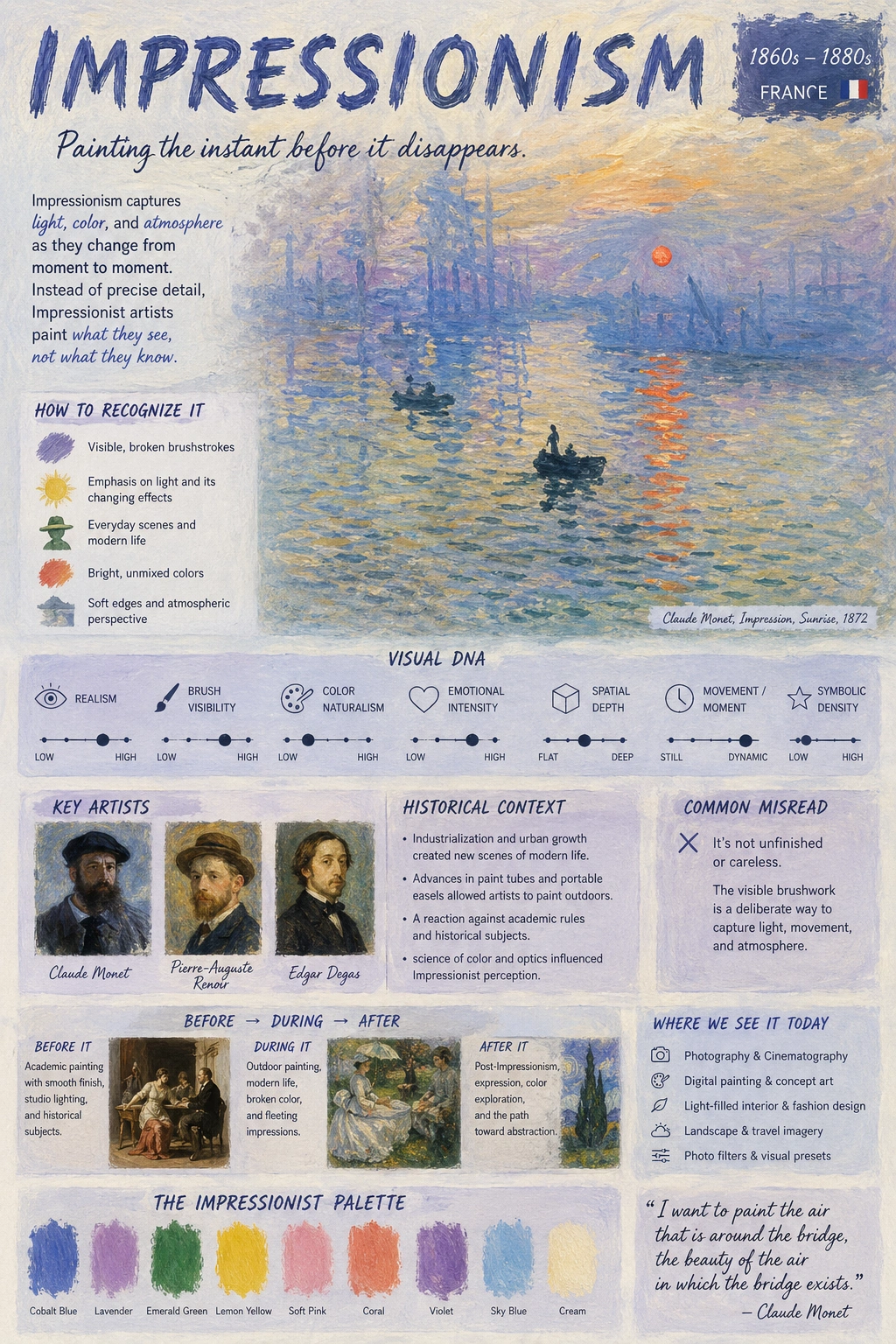
Its central thesis is:
Painting captures the instant before it disappears.
Instead of producing polished studio images, Impressionist painters explored light, air, weather, reflection, movement, and fleeting sensation. Their paintings often use broken brushwork, high-key color, visible texture, everyday subjects, and outdoor observation.
The key creative problem of Impressionism was:
How do you paint the instant before it disappears?
This makes Impressionism especially relevant today. Smartphone photography, cinematic color grading, lifestyle imagery, atmospheric rendering, and AI-generated visual softness often inherit something from Impressionist perception. The movement's influence is not limited to museums. It continues wherever images try to feel alive, temporary, and luminous.
Post-Impressionism and the Eye Becoming a Mind
Post-Impressionism moved beyond Impressionism's fleeting optics toward structure, emotion, symbol, pattern, and personal vision.
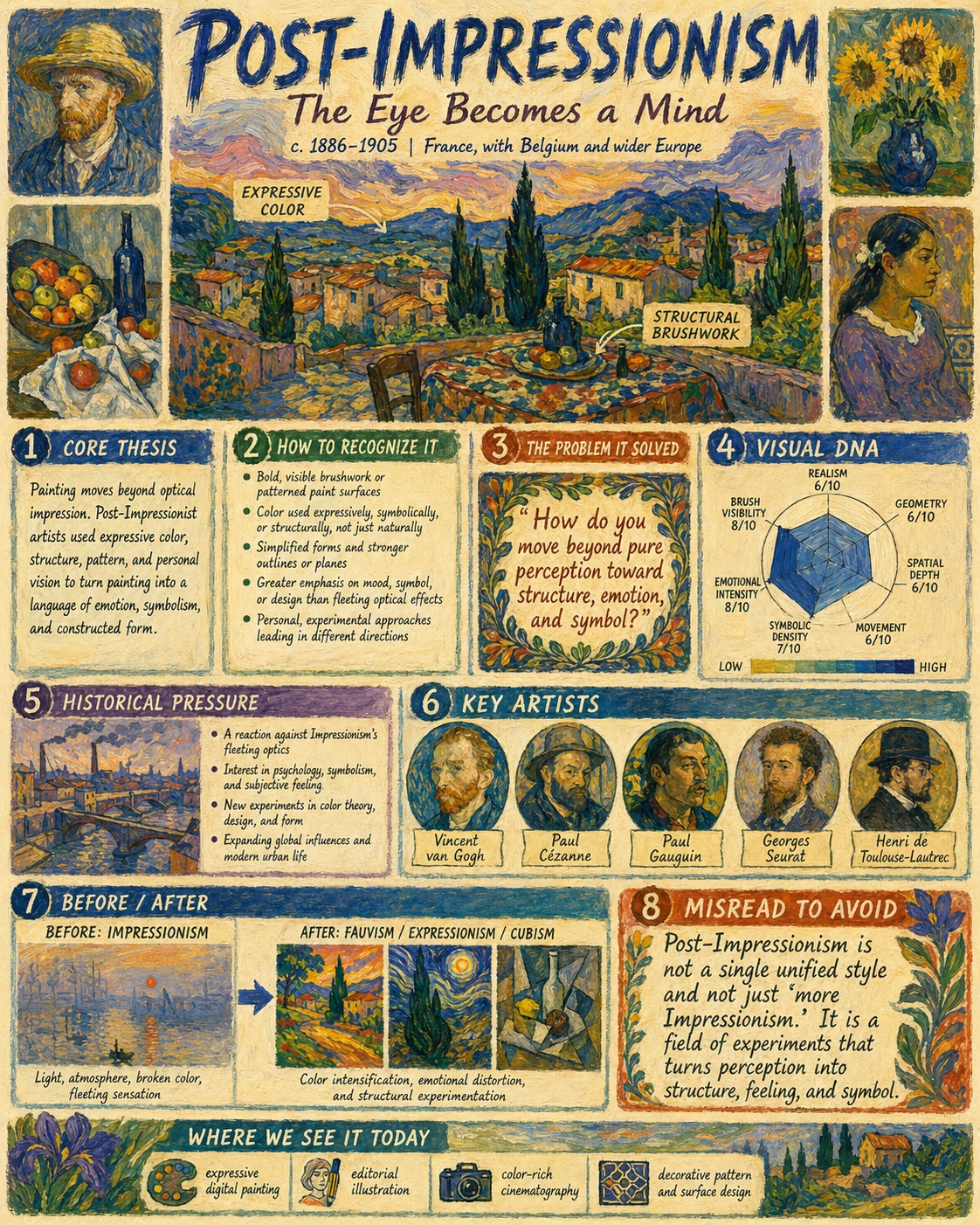
Its central thesis is:
The eye becomes a mind.
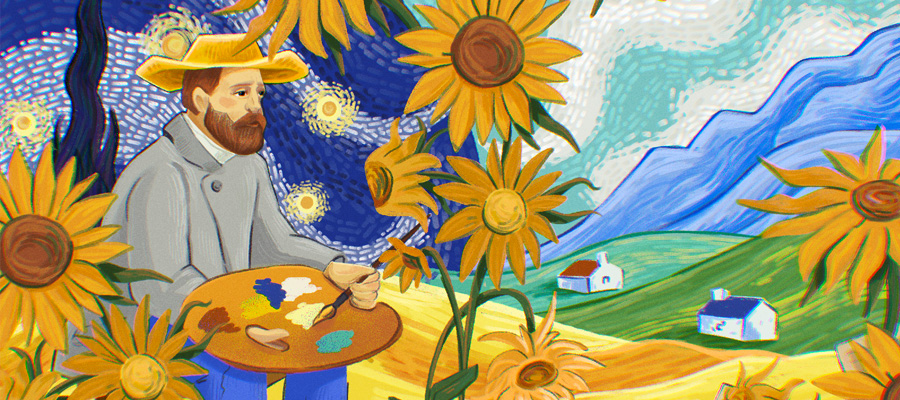
Post-Impressionist artists did not form one unified style. Instead, they opened several creative paths at once. Van Gogh intensified brushwork and emotional color. Cézanne rebuilt nature through structure. Gauguin pushed color toward symbol and myth. Seurat explored optical method and pointillist structure.
The key creative problem of Post-Impressionism was:
How do you move beyond pure perception toward structure, emotion, and symbol?
Post-Impressionism matters because it turns painting into a field of experiments. It prepares the ground for Fauvism, Expressionism, Cubism, Symbolism, abstraction, and modern design. It is one of the great creative hinge points in art history.
Symbolism and the Inner Myth
Symbolism shifted painting from external reality toward dream, myth, spirituality, psychology, and hidden meaning.
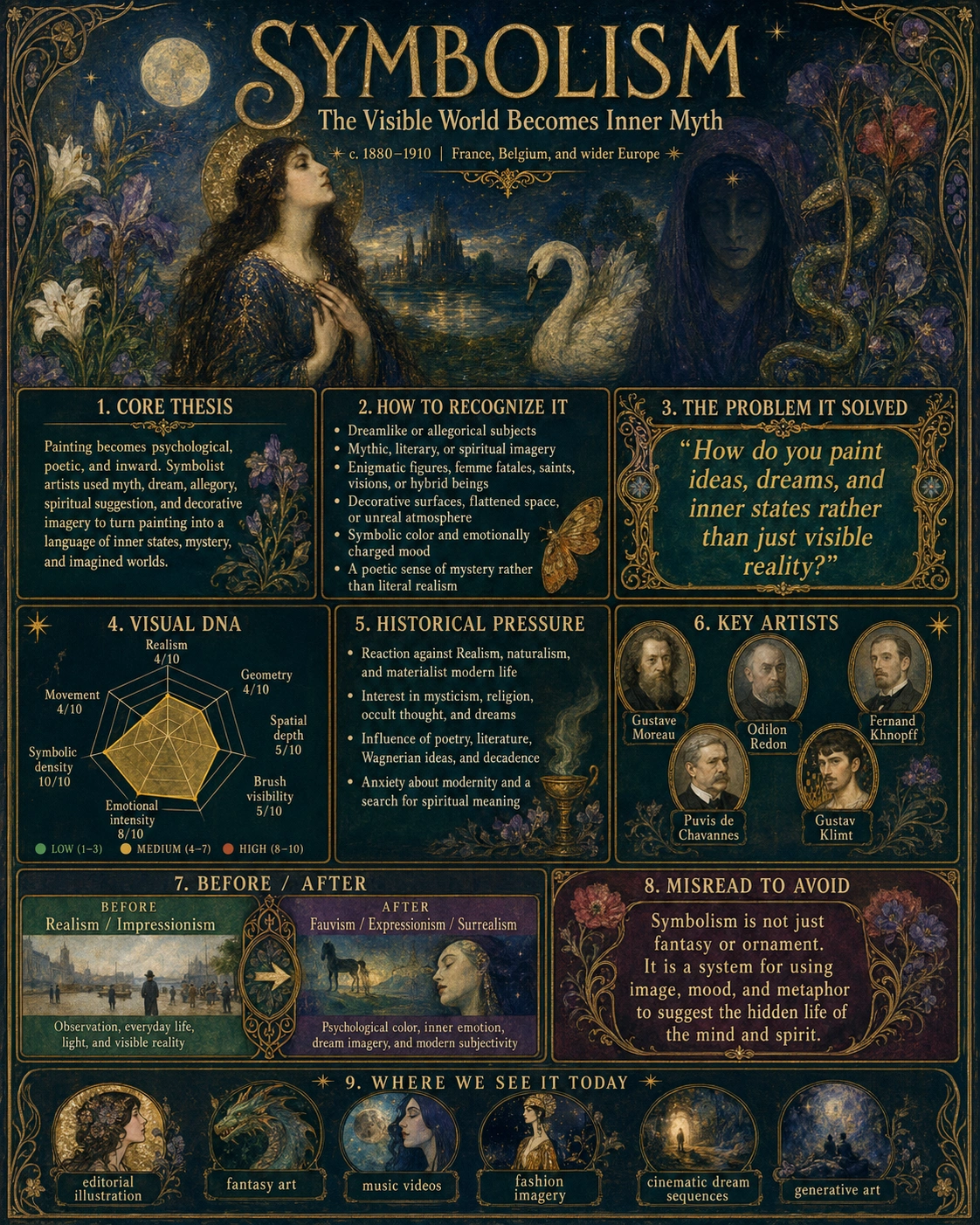
Its central thesis is:
The visible world becomes inner myth.
Symbolist painting is recognizable through dreamlike or allegorical subjects, mythic imagery, saints, femme fatales, visions, hybrid beings, symbolic color, decorative surfaces, mysterious landscapes, and poetic atmosphere.
The key creative problem of Symbolism was:
How do you paint ideas, dreams, and inner states rather than just visible reality?
Symbolism is not simply fantasy or ornament. It is a creative system for using image, mood, myth, and metaphor to suggest the hidden life of the mind and spirit. It remains deeply relevant to fantasy art, cinema, music videos, fashion imagery, and generative image culture.
Fauvism and Color as Instinct
Fauvism liberated color from natural description.
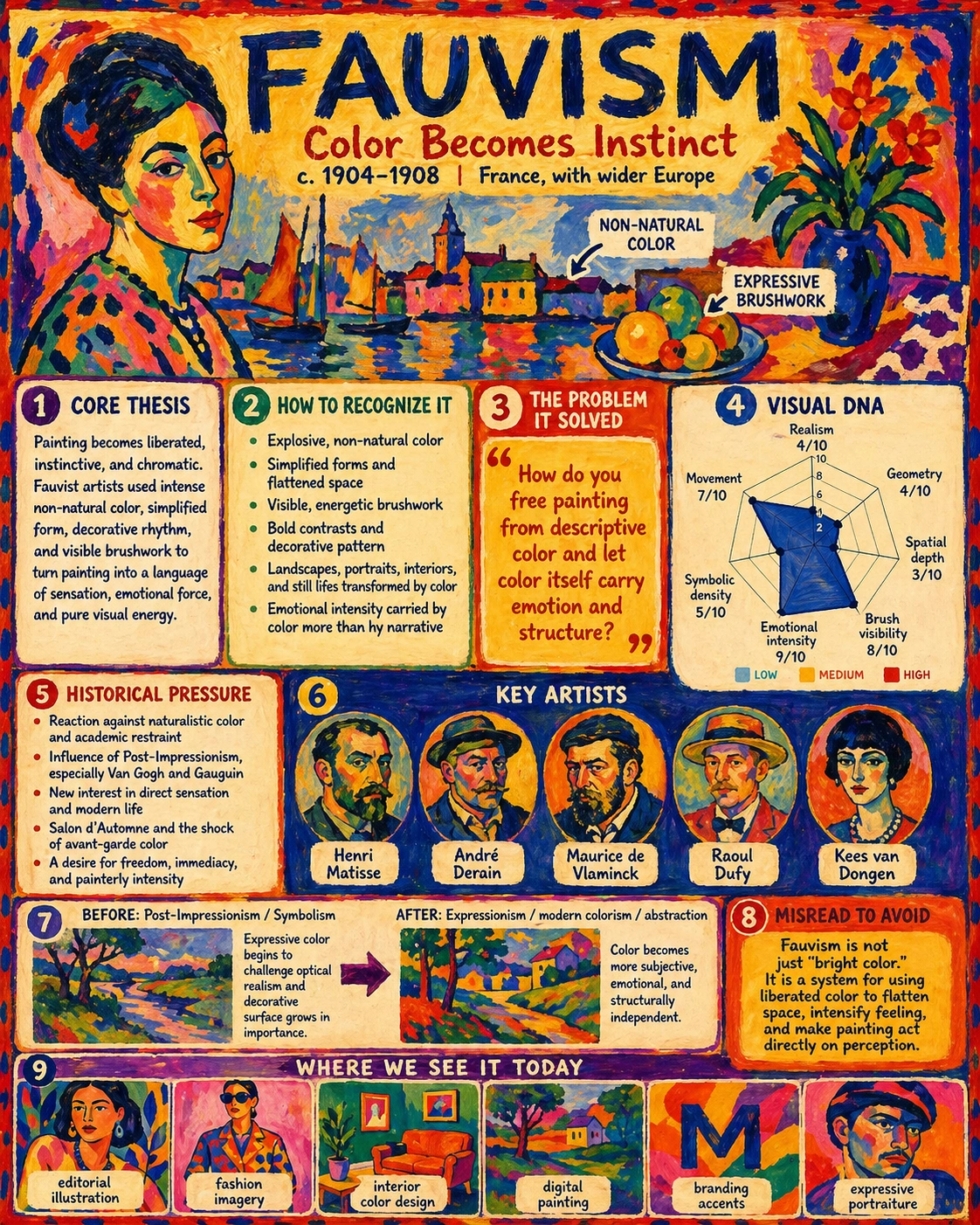
Its central thesis is:
Color becomes instinct.
Fauvist artists used intense non-natural color, simplified forms, visible brushwork, flattened space, and decorative rhythm. Landscapes, portraits, interiors, and still lifes became arenas for sensation rather than accurate depiction.
The key creative problem of Fauvism was:
How do you free painting from descriptive color and let color itself carry emotion and structure?
Fauvism is not just bright color. It is a creative system for using liberated color to flatten space, intensify feeling, and make painting act directly on perception.
Expressionism and Emotional Distortion
Expressionism pushed color, figure, line, and space toward psychological intensity.
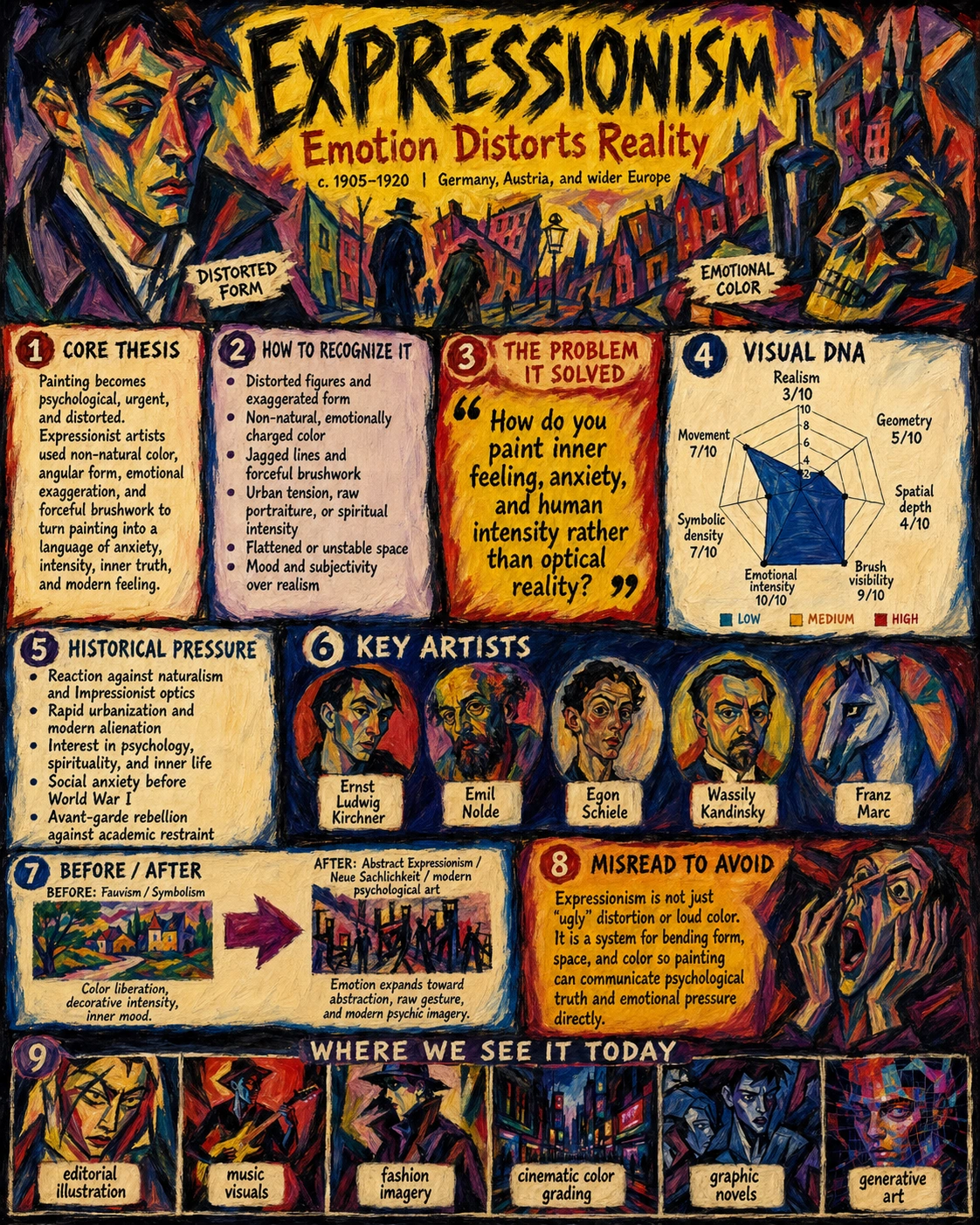
Its central thesis is:
Emotion distorts reality.
Expressionist painting is recognizable through distorted figures, angular forms, jagged lines, forceful brushwork, non-natural color, urban tension, spiritual intensity, raw portraiture, and unstable space.
The key creative problem of Expressionism was:
How do you paint inner feeling, anxiety, and human intensity rather than optical reality?
Expressionism is not merely ugly distortion or loud color. It is a creative system for bending form, space, and color so painting can communicate psychological truth directly. It remains influential in graphic novels, cinema, character design, music visuals, editorial illustration, and AI image aesthetics.
Cubism and the End of the Single Viewpoint
Cubism is one of the most important creative disruptions in modern painting.
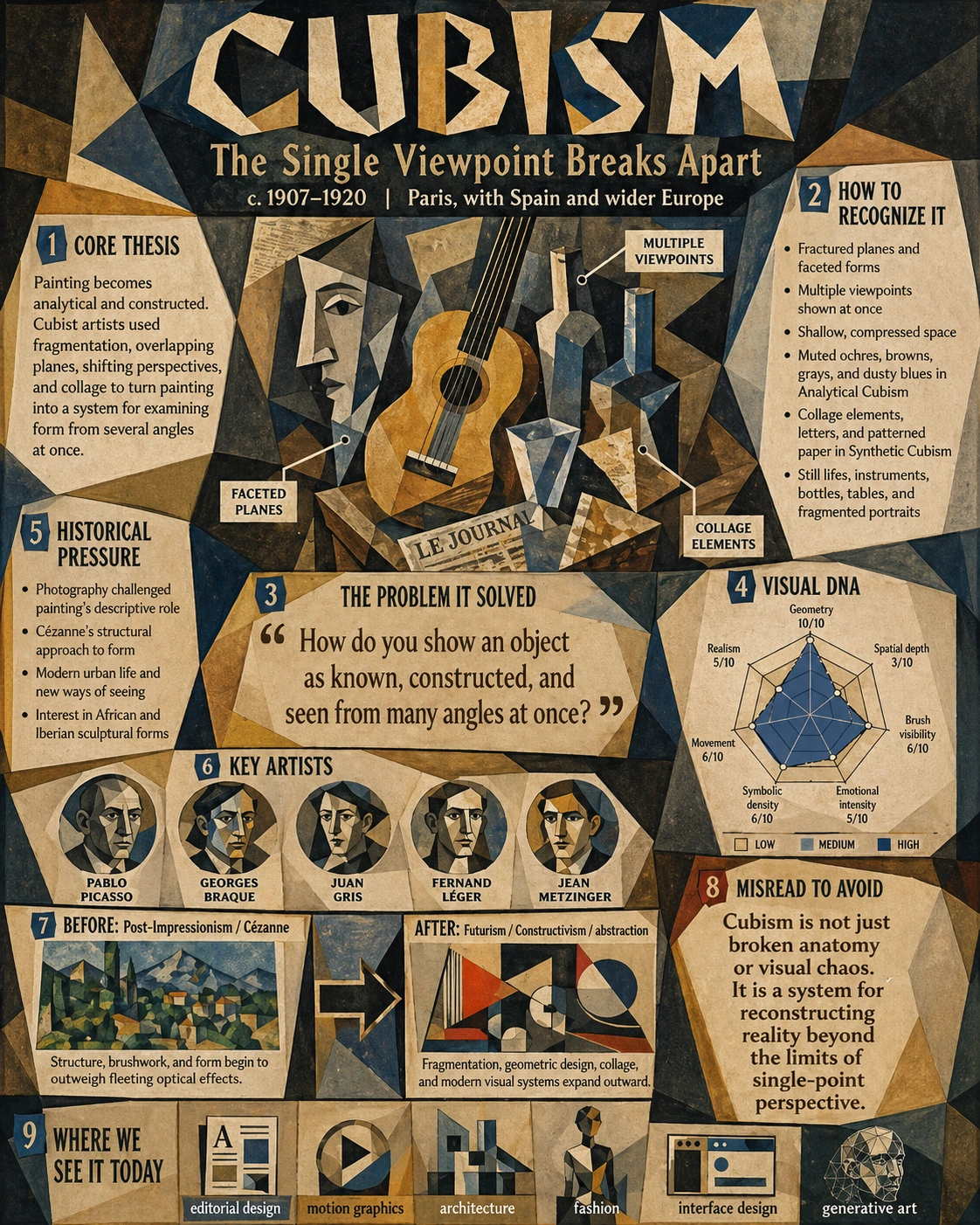
Its central thesis is:
The single viewpoint breaks apart.
Instead of showing an object from one fixed angle, Cubism breaks forms into planes, fragments, and overlapping perspectives. A face, bottle, guitar, table, or figure may seem compressed and fractured, but the distortion is not random. It is analytical.
The key creative problem of Cubism was:
How do you show that seeing is constructed?
Cubism matters because it destroyed the assumption that painting had to imitate optical reality. It opened the door to collage, abstraction, graphic design, fragmented typography, modern architecture, and experimental visual systems.
In contemporary creative culture, Cubism echoes through interface design, motion graphics, editorial layouts, generative art, deconstructed fashion, and cinematic montage.
Futurism and the Ideology of Speed
Futurism turned modern speed, machinery, violence, electricity, industry, and urban motion into visual language.
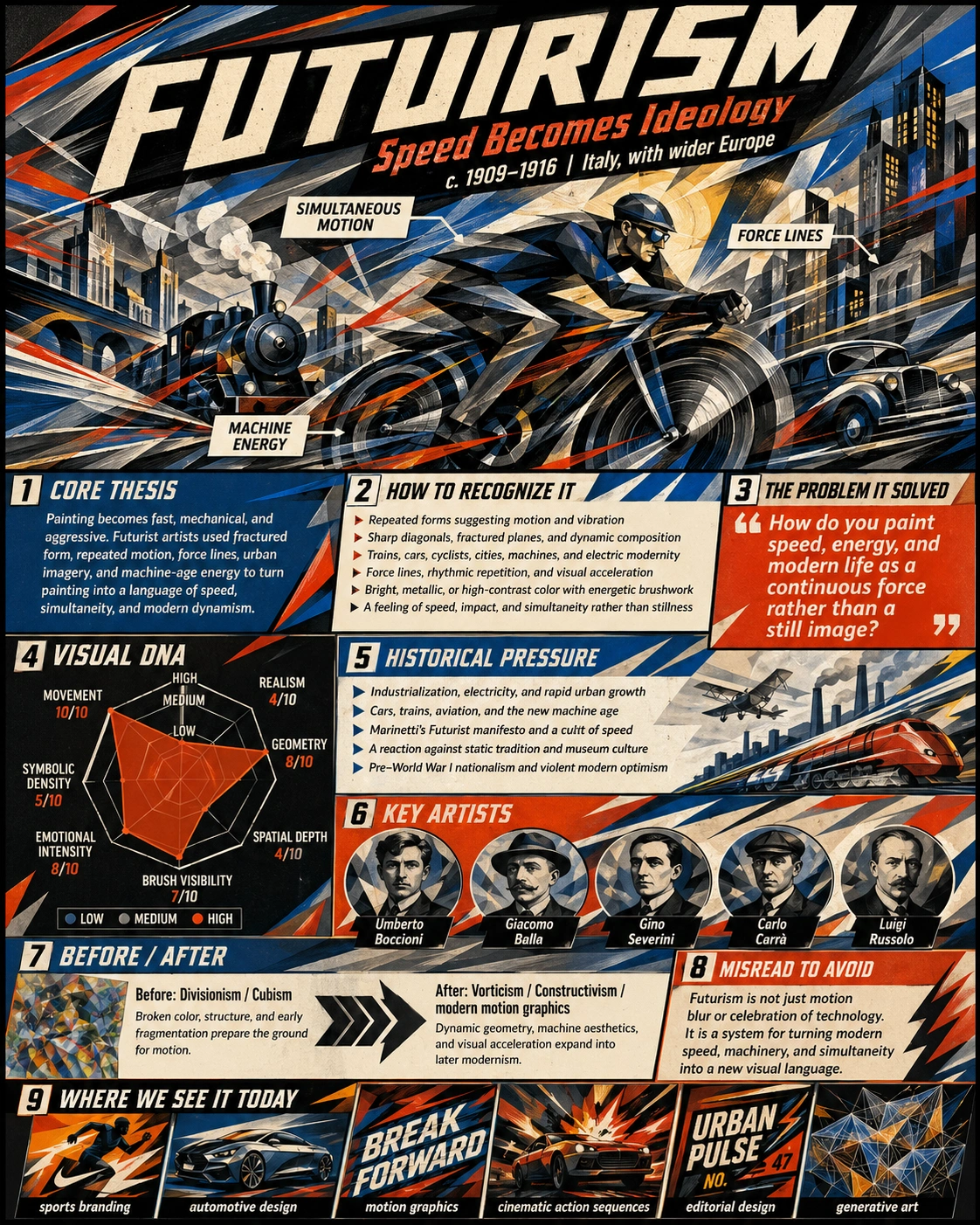
Its central thesis is:
Speed becomes ideology.
Futurist painting is recognizable through repeated forms, force lines, fractured planes, sharp diagonals, machines, cities, cyclists, trains, cars, airplanes, and the sensation of simultaneous motion.
The key creative problem of Futurism was:
How do you paint speed, energy, and modern life as continuous force rather than a still image?
Futurism is not just motion blur or a celebration of technology. It is a creative system for turning acceleration, machinery, and simultaneity into a visual language. Today, it echoes through automotive design, sports branding, cinematic action sequences, motion graphics, and high-speed editorial design.
Dada and Anti-Art as Art
Dada emerged from rupture, war, propaganda, absurdity, and revolt against cultural logic.
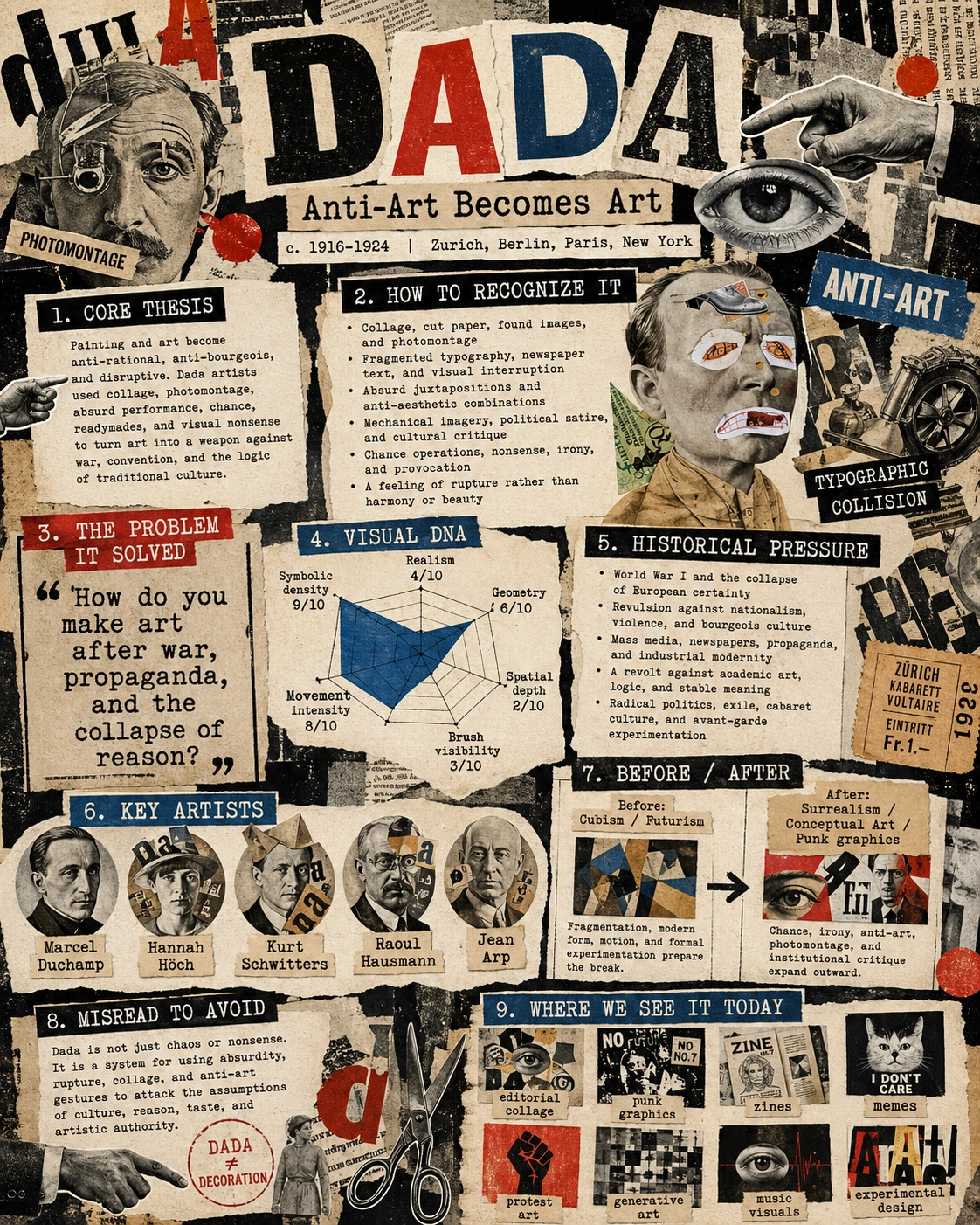
Its central thesis is:
Anti-art becomes art.
Dada is recognizable through collage, photomontage, found images, fragmented typography, absurd juxtapositions, readymades, mechanical imagery, chance operations, satire, and visual disruption.
The key creative problem of Dada was:
How do you make art after war, propaganda, and the collapse of reason?
Dada is not just chaos or nonsense. It is a creative system for using absurdity, rupture, collage, and anti-art gestures to attack assumptions about culture, reason, taste, and artistic authority. Its influence continues in memes, zines, punk graphics, protest design, experimental typography, and digital remix culture.
Constructivism and Art as Social Engineering
Constructivism transformed abstract form into social, political, and technological purpose.
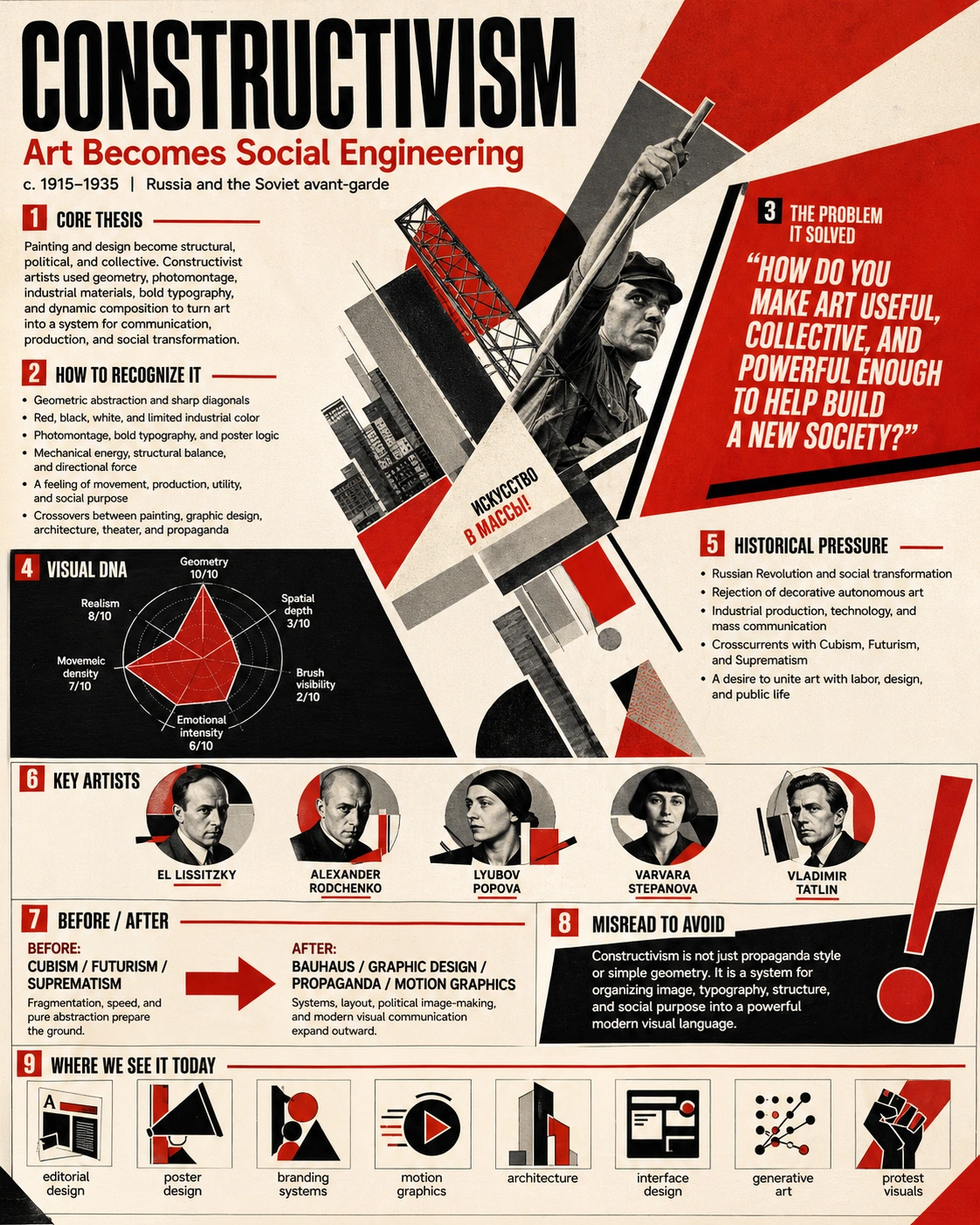
Its central thesis is:
Art becomes social engineering.
Constructivist work is recognizable through geometric structure, diagonal force, industrial materials, photomontage, bold typography, propaganda layouts, architectural thinking, and visual communication designed for mass society.
The key creative problem of Constructivism was:
How do you turn art into a tool for building a new society?
Constructivism is not only geometric abstraction. It is a creative system for combining art, design, politics, industry, and communication. Its legacy can be seen in editorial design, poster design, architecture, motion graphics, interface systems, branding, and visual activism.
De Stijl and Universal Geometry
De Stijl reduced painting to straight lines, rectangular forms, primary colors, white space, black structure, and asymmetrical balance.
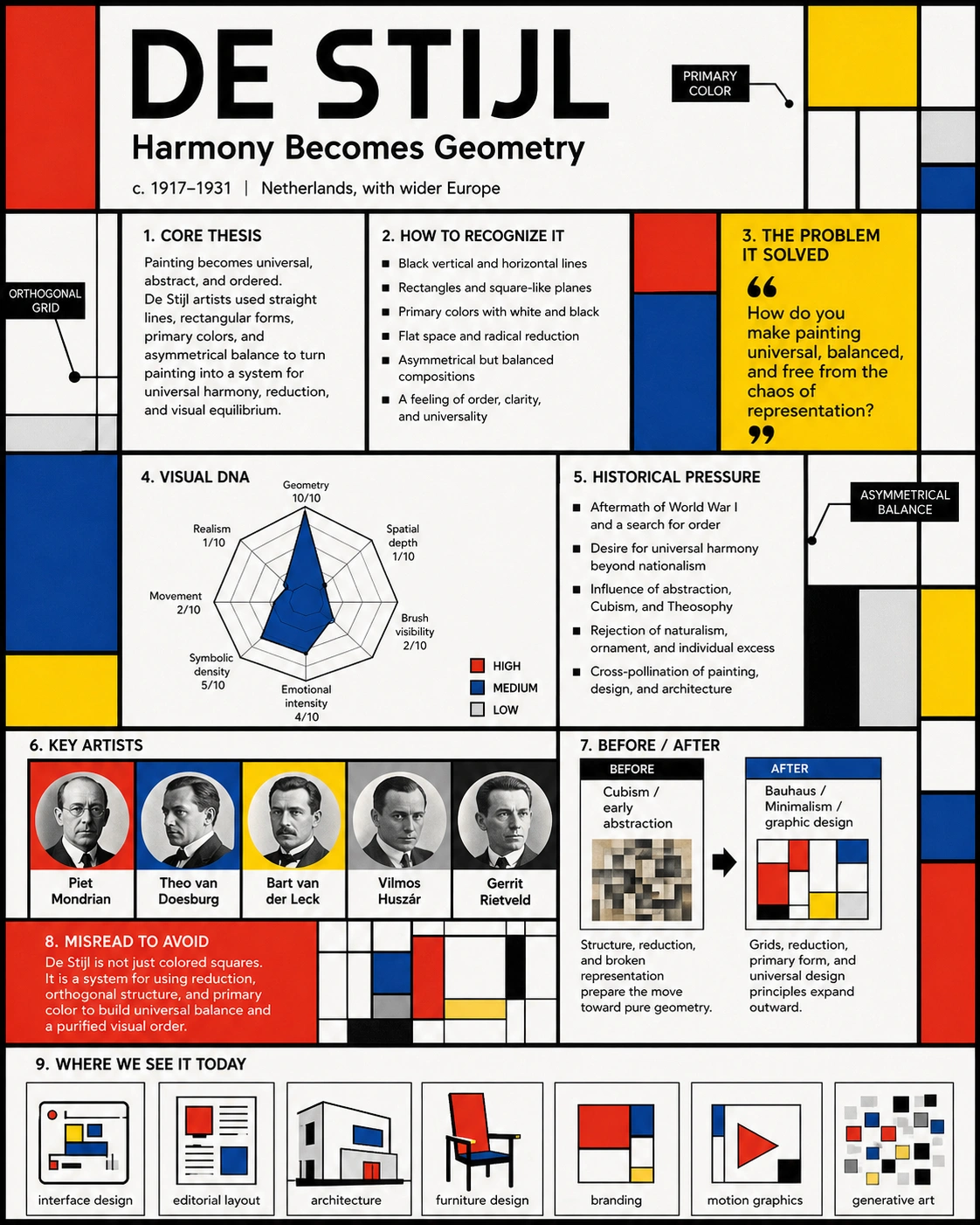
Its central thesis is:
Harmony becomes geometry.
De Stijl is recognizable through black vertical and horizontal lines, rectangles, primary colors, flat space, radical reduction, and a sense of universal balance.
The key creative problem of De Stijl was:
How do you make painting universal, balanced, and free from the chaos of representation?
De Stijl is not just colored squares. It is a creative system for using reduction, orthogonal structure, and primary color to build universal balance and purified visual order. Its afterlife is everywhere: interface design, editorial layout, architecture, furniture, branding, and motion graphics.
Suprematism and Pure Abstract Feeling
Suprematism pushed painting into radical non-objective abstraction.
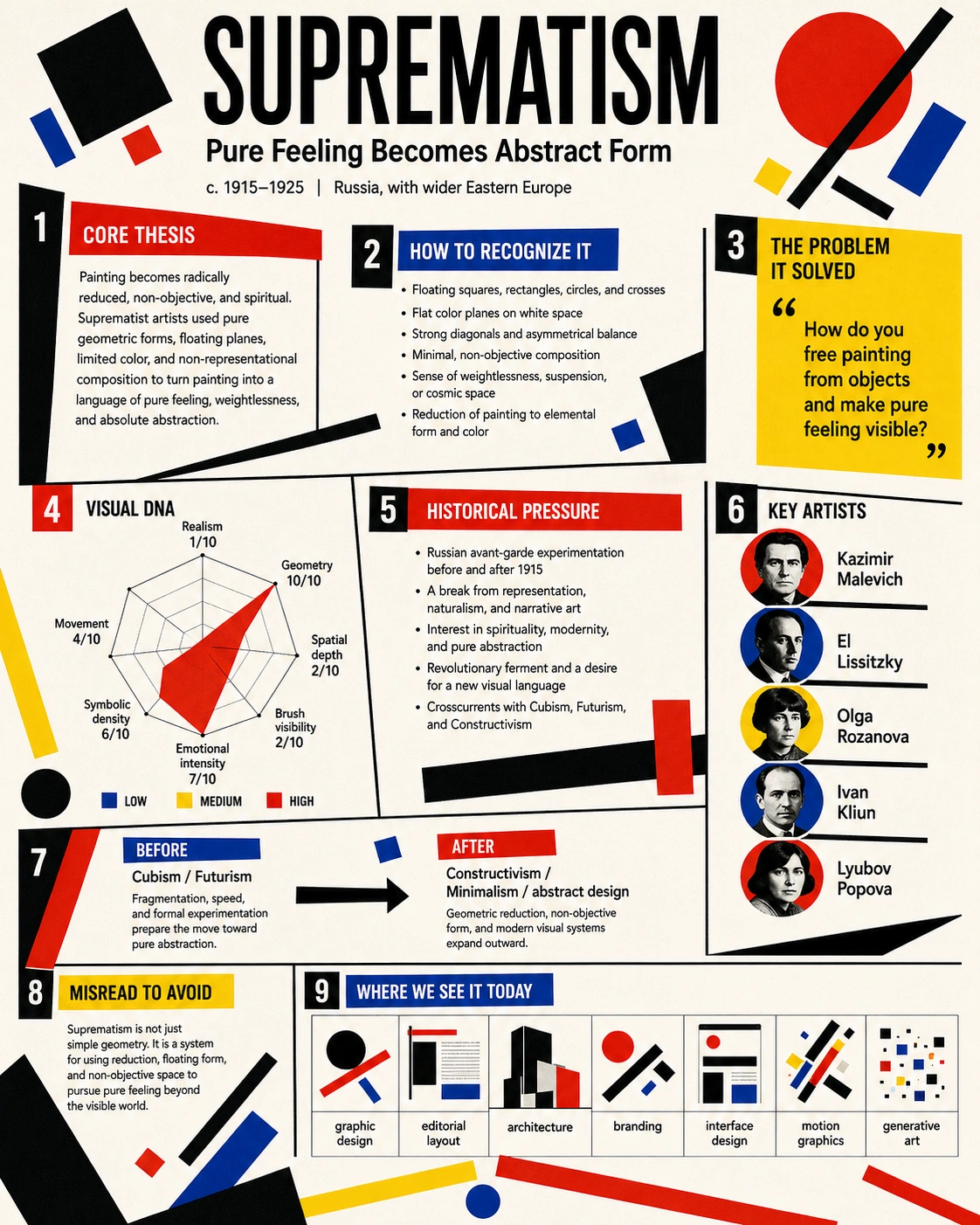
Its central thesis is:
Pure feeling becomes abstract form.
Suprematist painting is recognizable through floating squares, rectangles, circles, crosses, diagonals, white space, minimal composition, and a sense of weightlessness or cosmic suspension.
The key creative problem of Suprematism was:
How do you free painting from objects and make pure feeling visible?
Suprematism is not simply geometric minimalism. It is a creative system for using reduction, floating form, and non-objective space to pursue pure feeling beyond the visible world.
Bauhaus Painting and Modernist Abstraction
Bauhaus painting and modernist abstraction united painting, design, architecture, typography, craft, and technology.
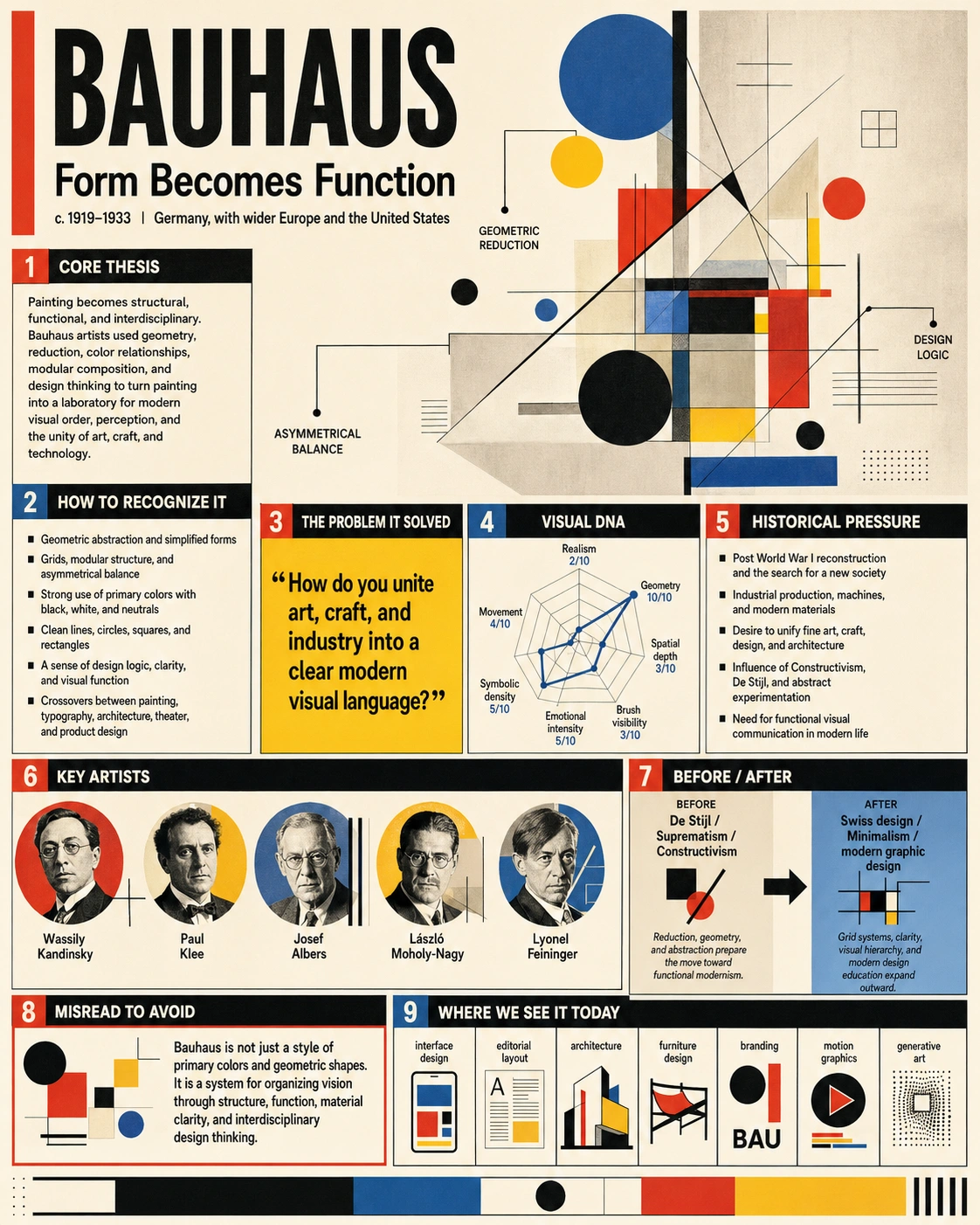
Its central thesis is:
Form follows visual function.
Bauhaus-related abstraction is recognizable through geometric forms, modular grids, primary colors, neutral fields, asymmetrical balance, circles, squares, rectangles, clean lines, and design logic.
The key creative problem of Bauhaus painting was:
How do you unite art, craft, and industry into a clear modern visual language?
This movement is central to the article because it shows painting becoming part of a broader creative system. The canvas becomes a laboratory for perception, structure, material clarity, education, architecture, product design, typography, and visual communication.
Surrealism and the Logic of Dreams
Surrealism is often remembered for strange imagery: melting forms, floating objects, impossible rooms, hybrid creatures, and mysterious landscapes. But its creative power comes from the tension between realistic technique and irrational content.
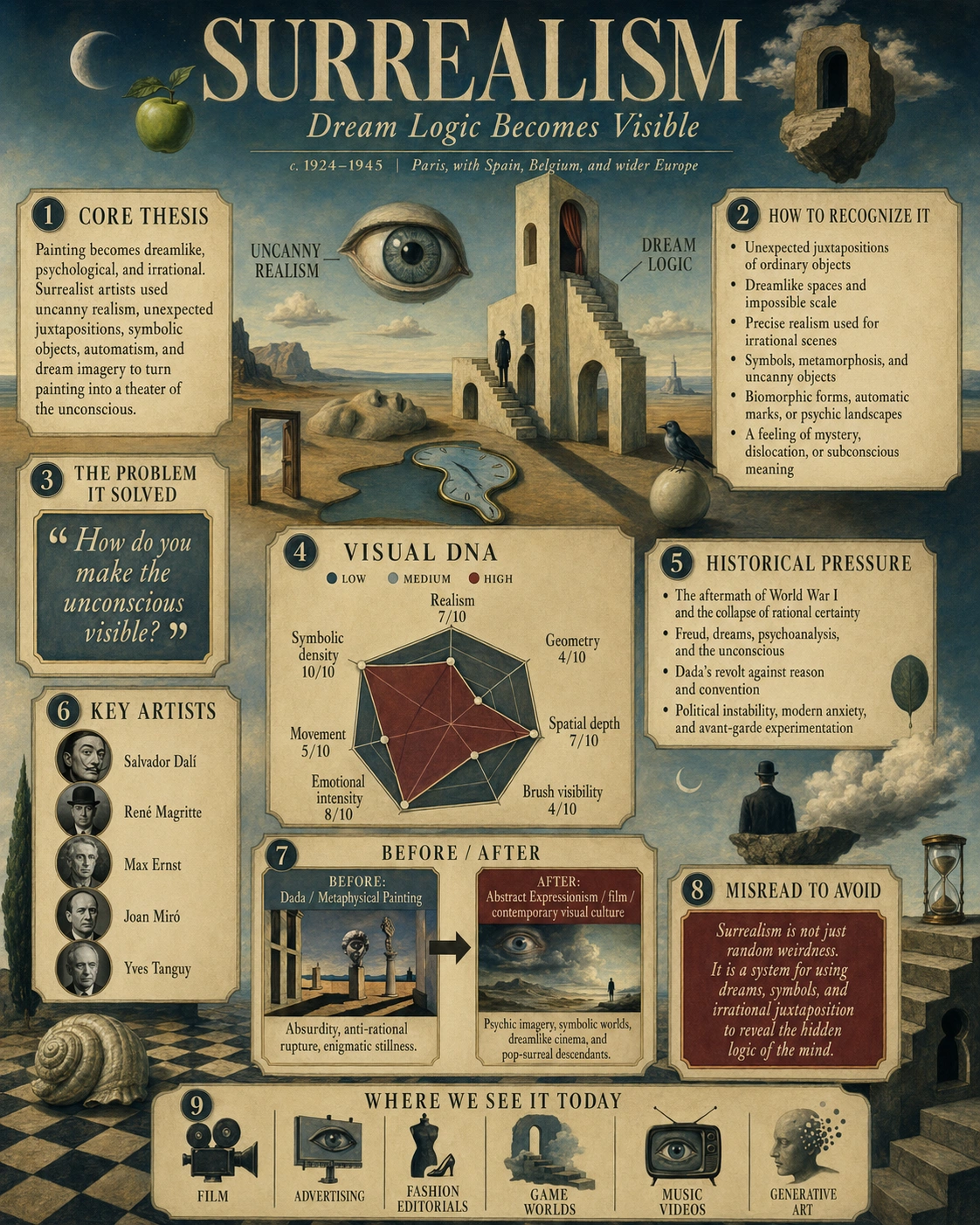
Its central thesis is:
Dream logic becomes visible.
Many Surrealist paintings look precise, polished, and spatially convincing. That realism makes the impossible more unsettling.
The key creative problem of Surrealism was:
How do you make the unconscious visible?
This is why Surrealism remains one of the most durable art styles in contemporary visual culture. Advertising, music videos, fashion editorials, fantasy cinema, game environments, and AI imagery constantly return to Surrealist strategies: impossible scale, dream logic, symbolic objects, uncanny realism, and emotional ambiguity.
Surrealism shows that creativity is not only invention. It is also the rearrangement of reality until hidden meanings emerge.
Abstract Expressionism and Painting as Event
Abstract Expressionism shifted attention from image to action.
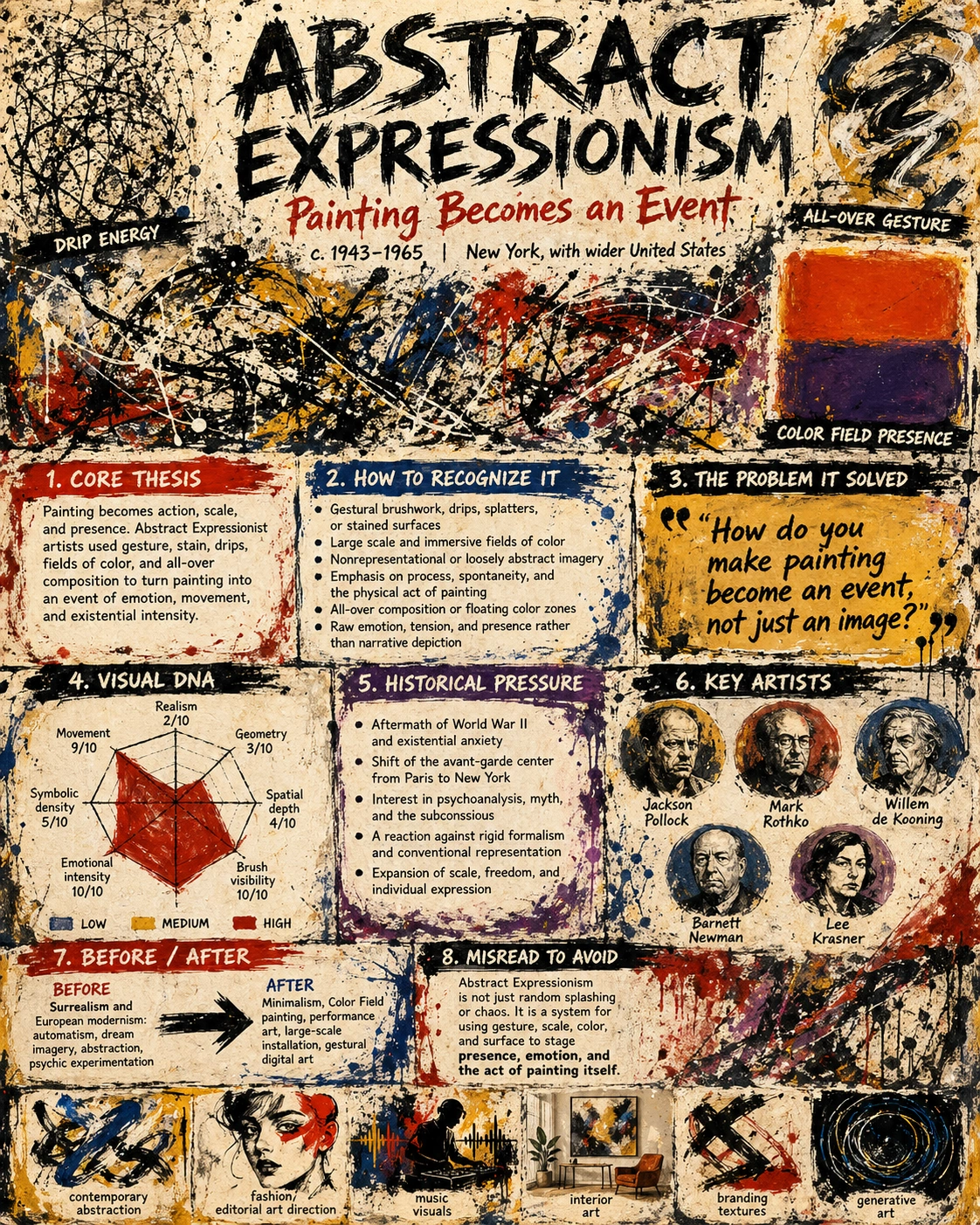
Its central thesis is:
Painting becomes an event.
The canvas became a record of movement, pressure, scale, rhythm, and physical presence. The painting no longer needed to depict a person, landscape, object, or story. It could become the trace of a creative act.
The key creative problem of Abstract Expressionism was:
How can painting become an event rather than an image?
This movement is essential for understanding contemporary abstraction, performance-based art, expressive mark-making, gestural design, and some forms of digital painting. The idea that an artwork can document energy rather than depict subject matter remains deeply influential.
Color Field Painting and Color as Environment
Color Field Painting moved away from gestural drama and toward large areas of color, atmosphere, surface, silence, scale, and emotional presence.
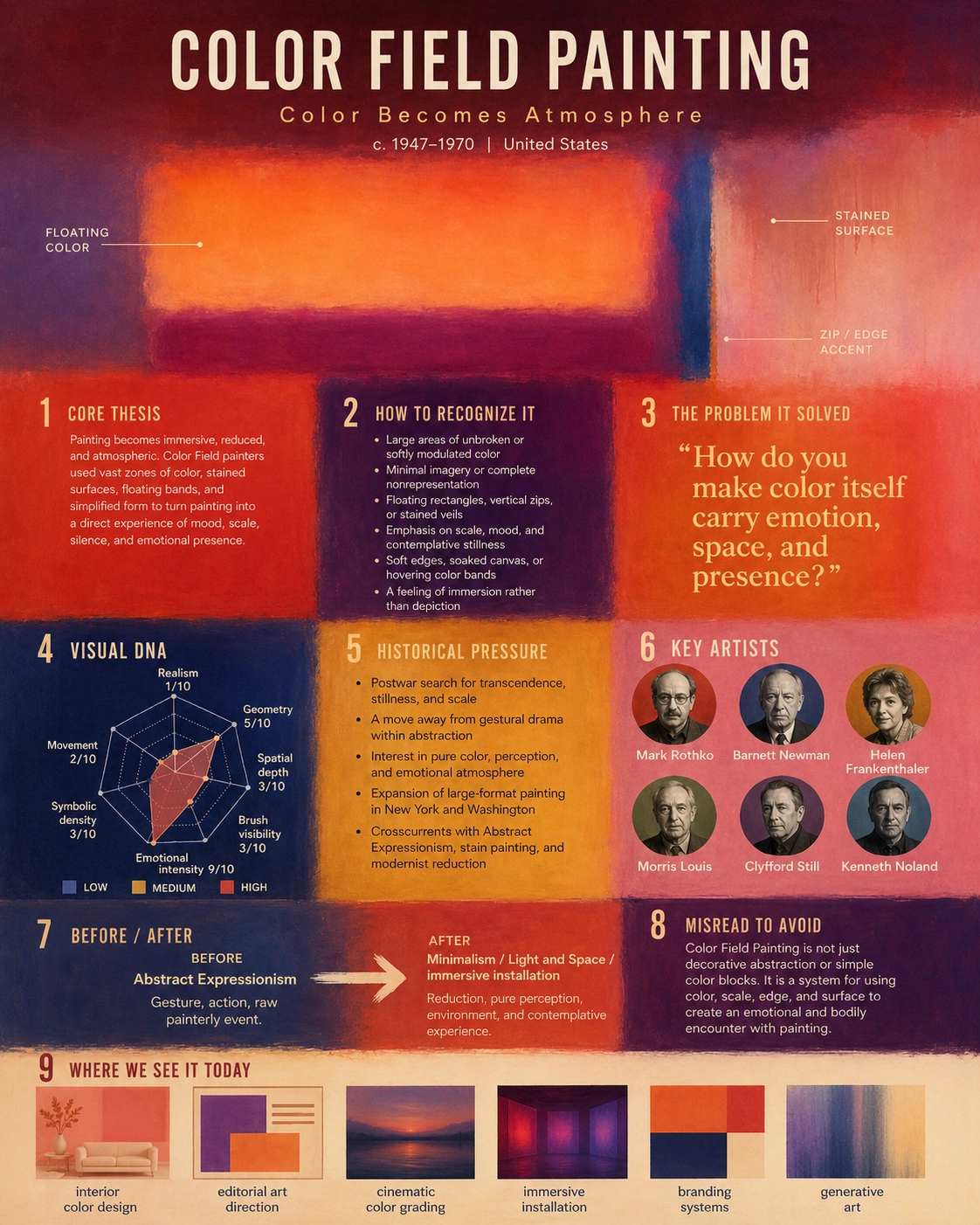
Its central thesis is:
Color becomes environment.
Color Field Painting is recognizable through vast zones of unbroken or softly modulated color, stained surfaces, floating bands, vertical zips, reduced imagery, soft edges, and contemplative stillness.
The key creative problem of Color Field Painting was:
How do you make color itself carry emotion, space, and presence?
Color Field Painting is not just decorative abstraction or simple color blocks. It is a creative system for using color, scale, edge, and surface to create an emotional and bodily encounter with painting.
Pop Art and the Image-Saturated World
Pop Art brought mass culture into the space of fine art.
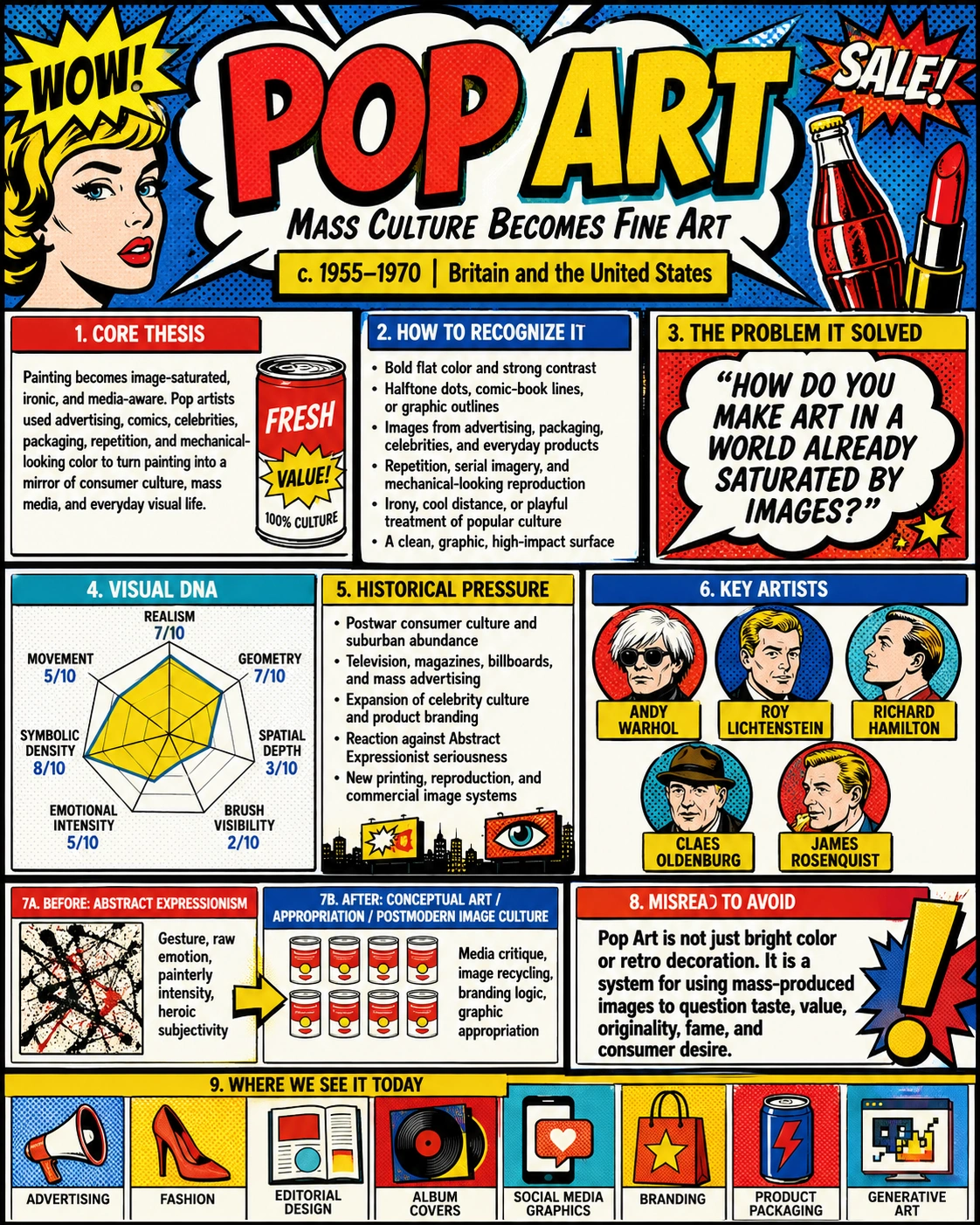
Its central thesis is:
Mass culture becomes fine art.
Instead of rejecting advertising, comics, packaging, celebrities, and consumer products, Pop Art absorbed them. It understood that modern life was already full of images. The supermarket, magazine cover, movie star, and billboard became creative material.
The key creative problem of Pop Art was:
How do you make art in a world already saturated by images?
This question feels even more urgent now. Social media, memes, branding, influencer culture, product photography, streaming platforms, and AI image feeds all intensify the Pop Art condition. We do not merely look at images. We live inside image systems.
That makes Pop Art one of the most contemporary movements in the series.
Minimalism and Painting as Object
Minimalism reduced painting to form, surface, repetition, objecthood, scale, and direct perception.
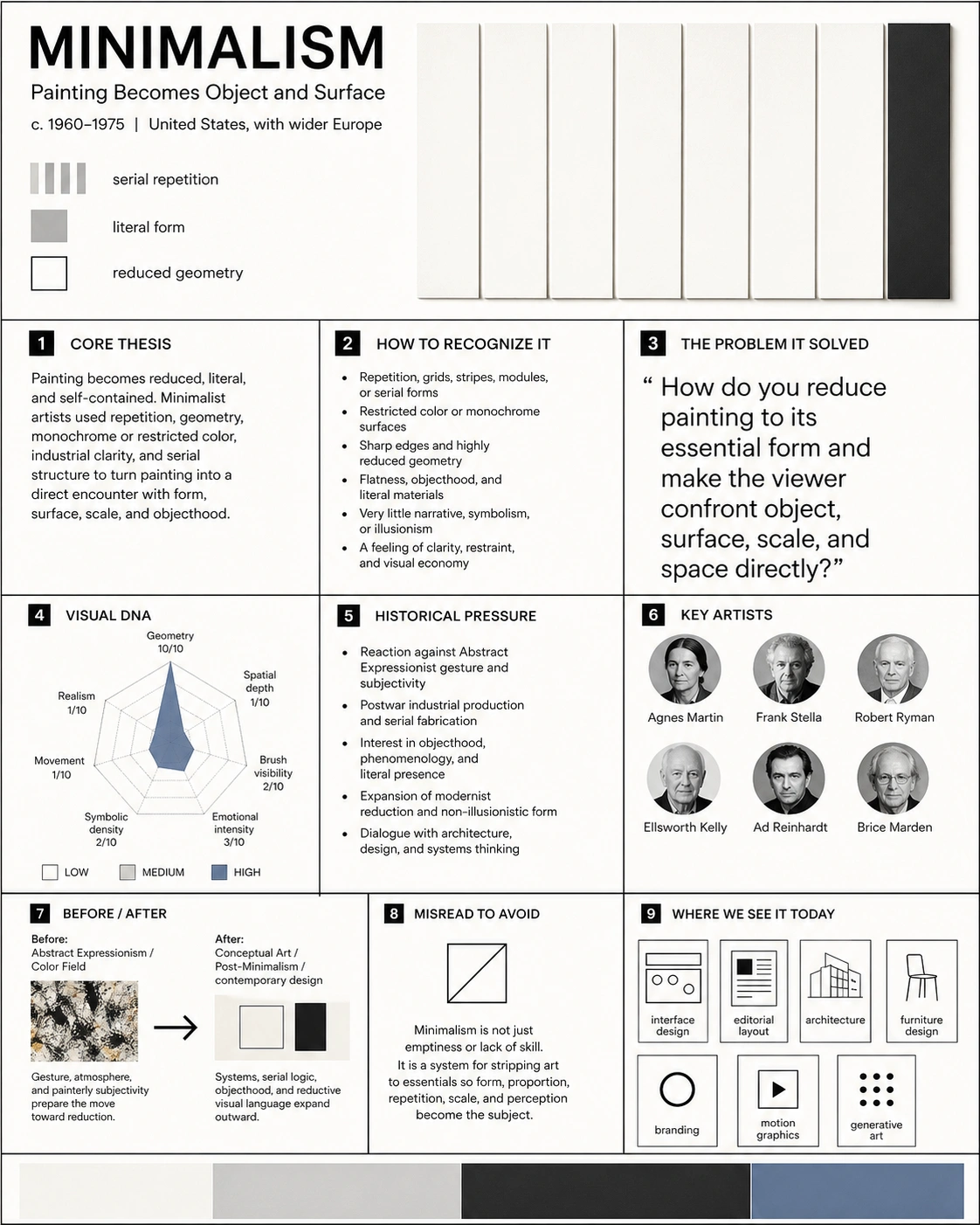
Its central thesis is:
Painting becomes object and surface.
Minimalist painting is recognizable through serial repetition, grids, stripes, monochrome or restricted color, hard edges, industrial clarity, flatness, literal materials, and very little symbolism or narrative.
The key creative problem of Minimalism was:
How do you reduce painting to its essential form and make the viewer confront object, surface, scale, and space directly?
Minimalism is not emptiness or lack of skill. It is a creative system for stripping art to essentials so form, proportion, repetition, scale, and perception become the subject.
Op Art and Optical Instability
Op Art made perception itself the subject.
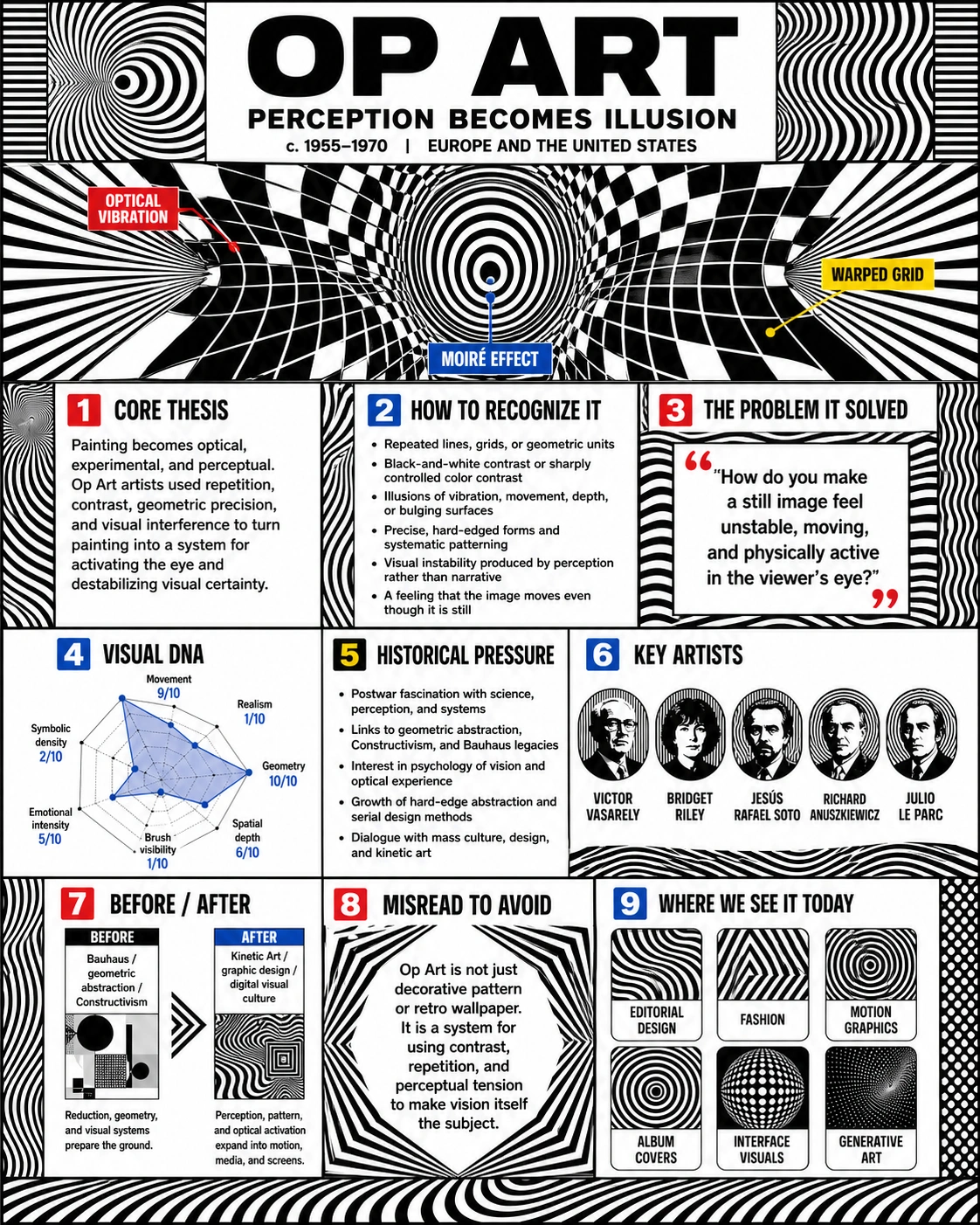
Its central thesis is:
Vision becomes optical instability.
Op Art is recognizable through repeated lines, grids, geometric units, black-and-white contrast, controlled color contrast, optical vibration, moiré effects, warped patterns, and illusions of movement, depth, or bulging surfaces.
The key creative problem of Op Art was:
How do you make a still image feel unstable, moving, and physically active in the viewer's eye?
Op Art is not just decorative pattern or retro wallpaper. It is a creative system for using contrast, repetition, and perceptual tension to make vision itself unstable. It connects painting to psychology, optics, design, kinetic art, fashion, interface visuals, and digital screen culture.
Photorealism and the Authority of the Camera
Photorealism brought painting into direct competition with photography.
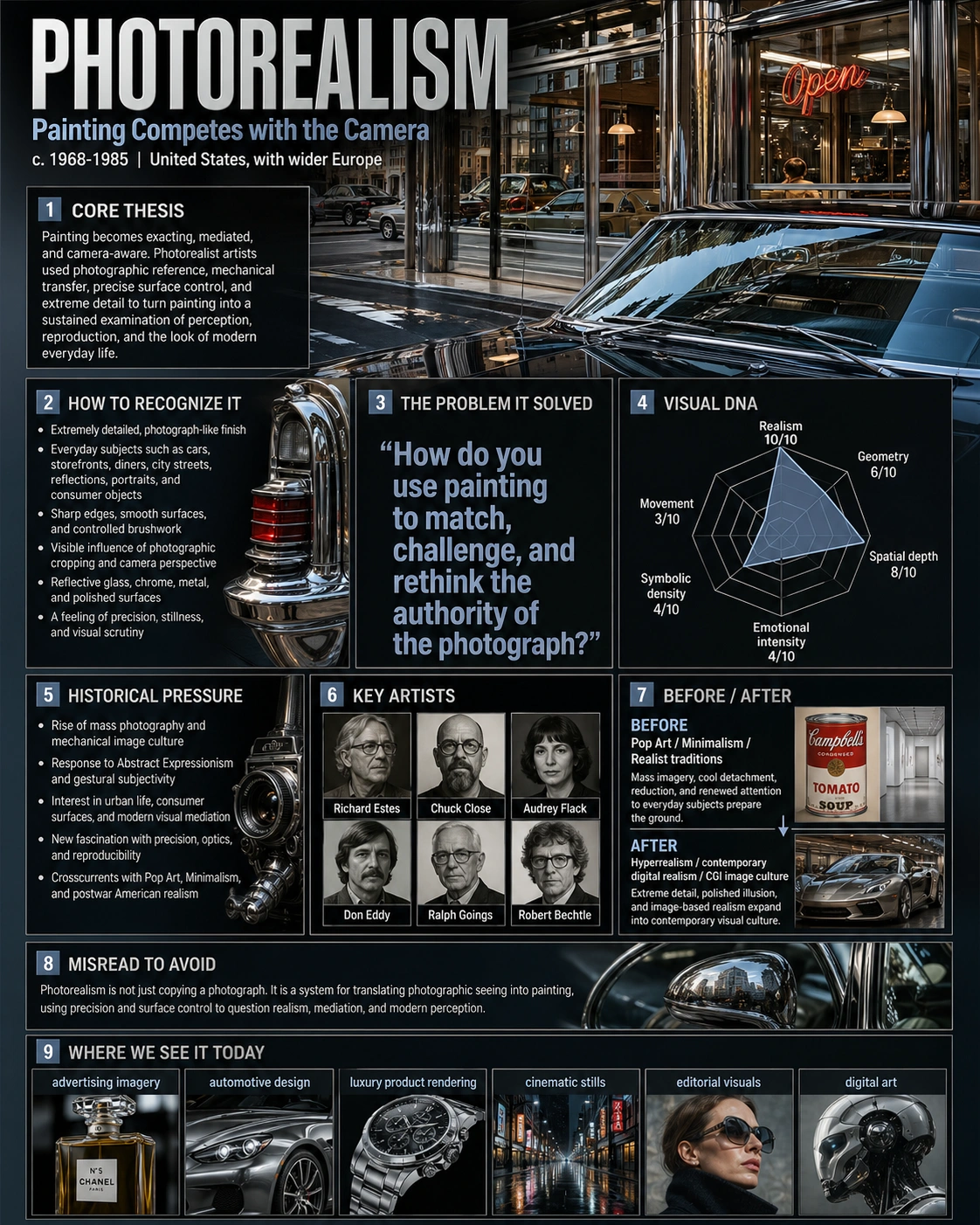
Its central thesis is:
Painting competes with the camera.
Photorealist artists used photographic references, mechanical transfer, precise surface control, sharp edges, reflections, chrome, glass, cars, storefronts, portraits, consumer objects, and urban environments.
The key creative problem of Photorealism was:
How do you use painting to match, challenge, and rethink the authority of the photograph?
Photorealism is not just copying a photograph. It is a creative system for translating photographic seeing into painting, using precision and surface control to question realism, mediation, and modern perception.
Neo-Expressionism and the Return of Raw Gesture
Neo-Expressionism reacted against Minimalism and Conceptual Art by bringing back rough figuration, historical memory, myth, identity, cultural anxiety, and aggressive painterly gesture.
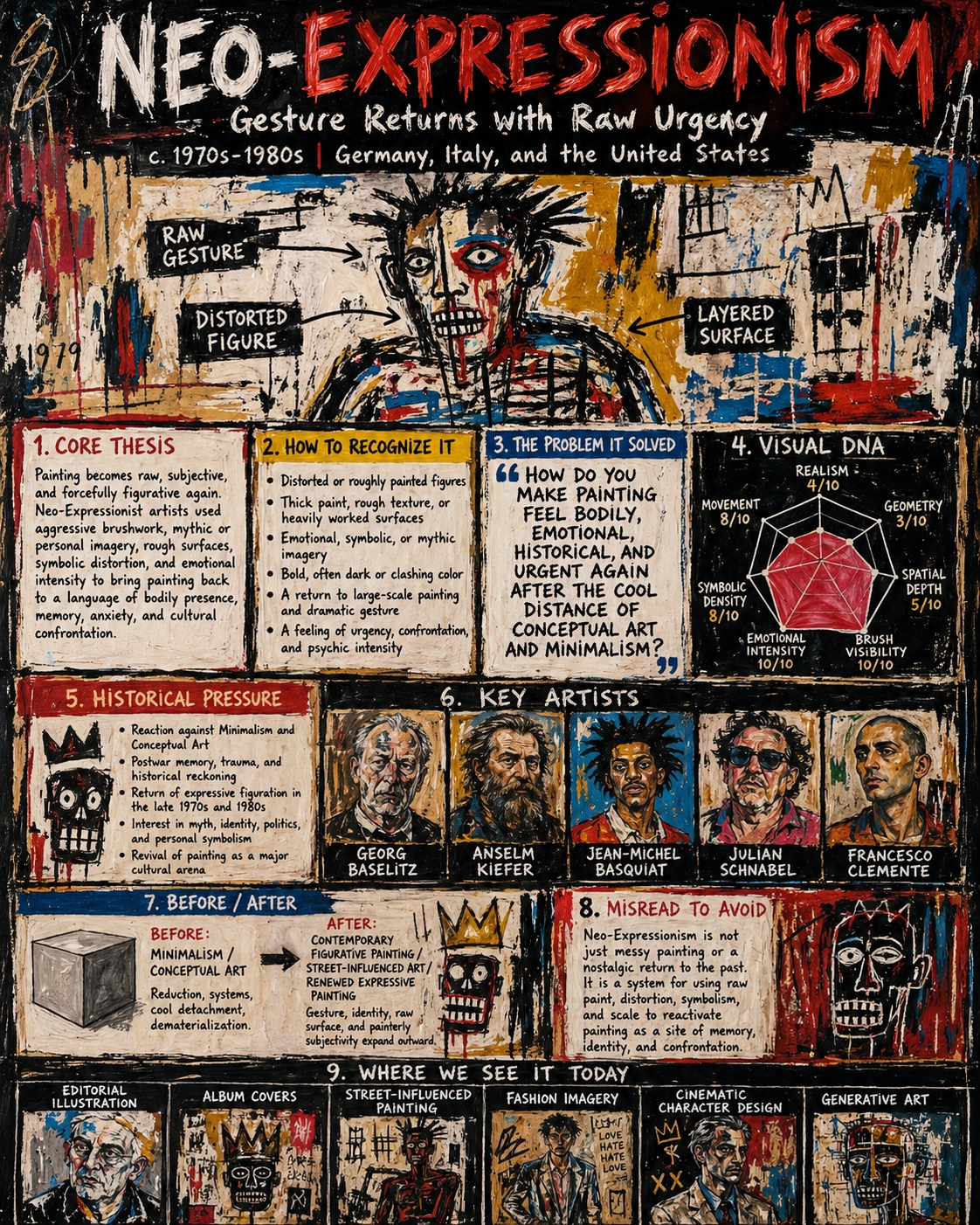
Its central thesis is:
Gesture returns after conceptual coolness.
Neo-Expressionist painting is recognizable through distorted figures, thick paint, rough surfaces, symbolic imagery, dark or clashing color, large scale, dramatic marks, and psychological urgency.
The key creative problem of Neo-Expressionism was:
How do you make painting feel bodily, emotional, historical, and urgent again after the cool distance of Conceptual Art and Minimalism?
Neo-Expressionism is not just messy painting or nostalgia. It is a creative system for using raw paint, distortion, symbolism, and scale to reactivate painting as a site of memory, identity, conflict, and confrontation.
Street Art and Graffiti Art as Public Image-Making
Street Art and Graffiti Art moved visual culture out of galleries and into public space.
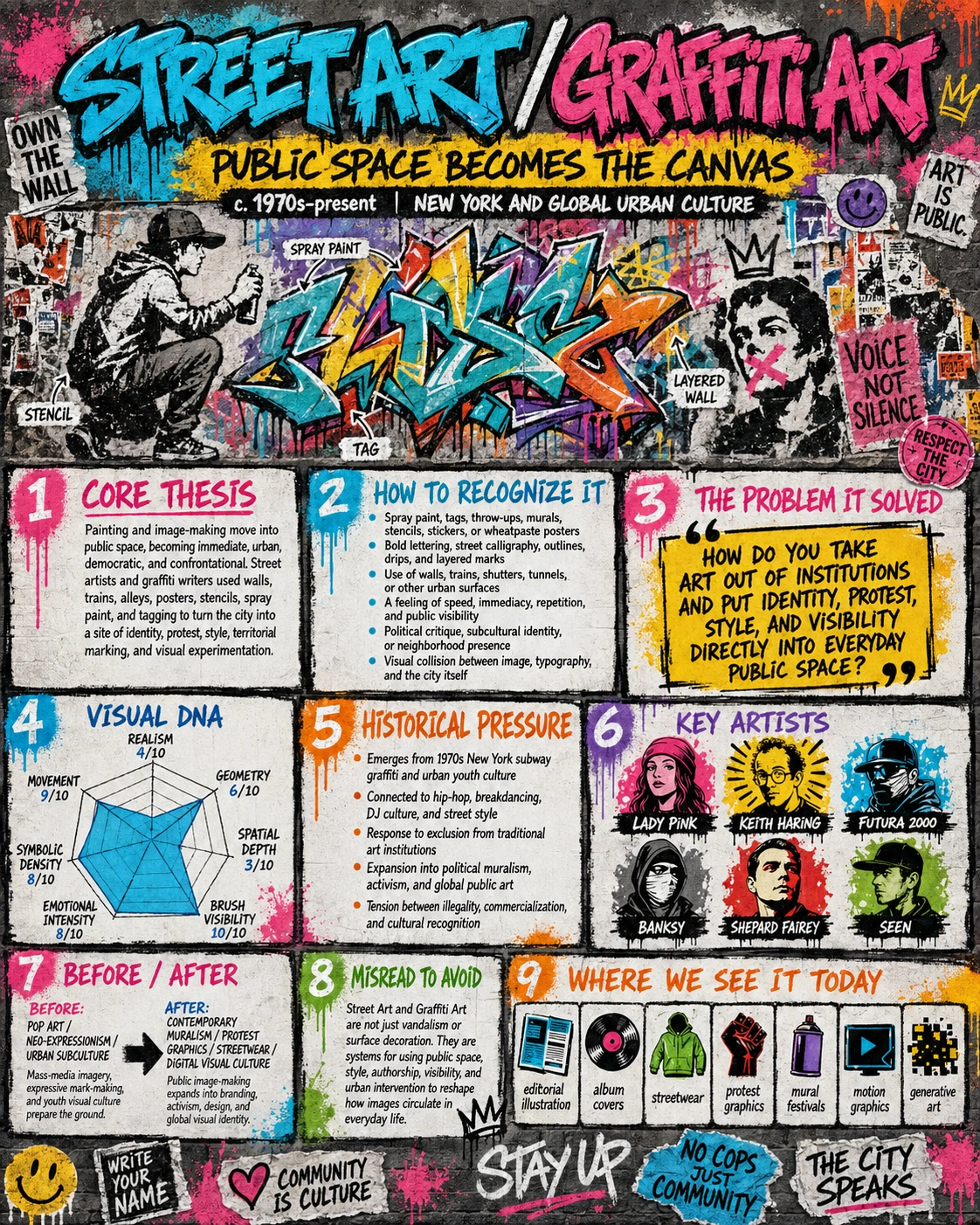
Its central thesis is:
Public space becomes the canvas.
Street Art and Graffiti Art are recognizable through spray paint, tags, throw-ups, murals, stencils, wheatpaste posters, layered walls, bold lettering, drips, outlines, stickers, urban surfaces, political critique, neighborhood presence, and visual collision.
The key creative problem of Street Art and Graffiti Art was:
How do you take art out of institutions and put identity, protest, style, and visibility directly into everyday public space?
This movement is not merely vandalism or surface decoration. It is a creative system for using public space, authorship, visibility, and urban intervention to reshape how images circulate in everyday life.
Digital Painting and AI-Era Image Culture
The final infographic brings the series into the present with Digital Painting and AI-era image culture.
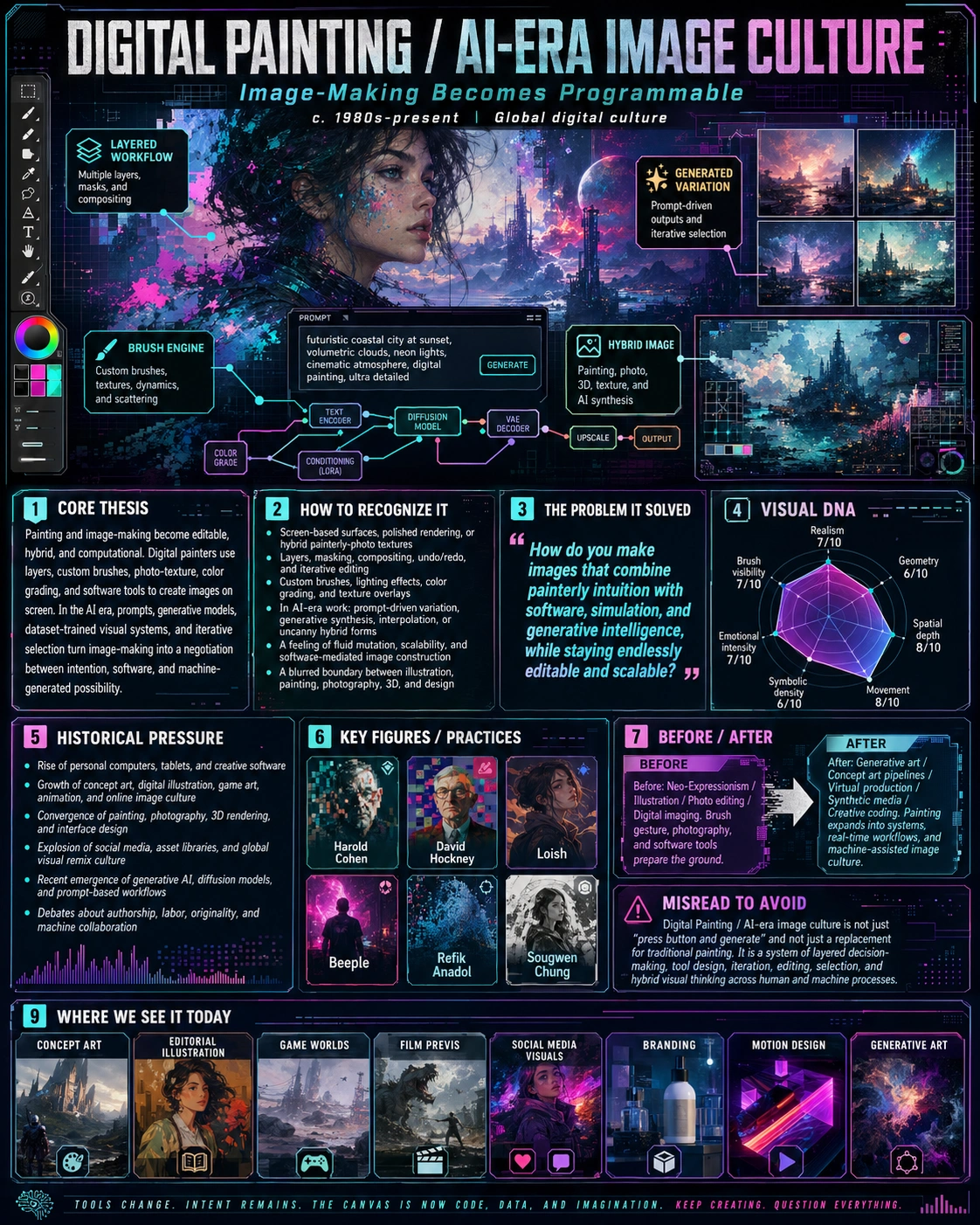
Its central thesis is:
Style becomes programmable.
Digital painting uses screen-based surfaces, custom brushes, layers, masks, compositing, undo and redo, photo-texture, lighting effects, color grading, 3D references, and iterative editing. In the AI era, image-making also involves prompts, generative models, dataset-trained visual systems, variation, upscaling, selection, and hybrid workflows between human intention and machine-generated possibility.
The key creative problem of Digital Painting and AI-era image culture is:
How do you make images that combine painterly intuition with software, simulation, and generative intelligence, while staying editable and scalable?
This is not simply "press button and generate." It is a creative system of decision-making, iteration, direction, editing, selection, authorship, and hybrid visual thinking. The canvas is no longer only cloth, wall, paper, or panel. It is also code, data, interface, model, prompt, archive, and feedback loop.
The Bigger Idea: Every Style Is a Creative Answer
The most important idea behind this project is that painting styles should not be presented as a simple timeline of progress.
Art history is not a straight line from "less realistic" to "more realistic," or from "traditional" to "modern." That model is too narrow. A Renaissance fresco, a Baroque altarpiece, a Rococo interior scene, a Realist worker, an Impressionist landscape, a Cubist still life, a Suprematist square, a Pop Art product image, and an AI-era digital composition are not competing to solve the same problem.
They are answering different creative questions.
- Renaissance painting asks how to organize visible space.
- Baroque painting asks how to move the viewer emotionally.
- Rococo asks how pleasure, intimacy, and ornament can become visual atmosphere.
- Neoclassicism asks how painting can embody reason, virtue, and civic seriousness.
- Romanticism asks how painting can express emotion, nature, and the sublime.
- Realism asks how ordinary life becomes historically important.
- Impressionism asks how perception changes moment by moment.
- Post-Impressionism asks how perception becomes structure, emotion, and symbol.
- Symbolism asks how dreams, myths, and inner states can become visible.
- Fauvism asks how color can become instinctive force.
- Expressionism asks how emotion can distort reality truthfully.
- Cubism asks how reality can be shown from multiple viewpoints.
- Futurism asks how speed, machinery, and simultaneity can become visual energy.
- Dada asks how art can survive after reason collapses.
- Constructivism asks how art can help build a new society.
- De Stijl asks how painting can become universal harmony through geometry.
- Suprematism asks how pure feeling can exist beyond objects.
- Bauhaus abstraction asks how art, craft, design, and industry can become one visual language.
- Surrealism asks how dreams and the unconscious can become visible.
- Abstract Expressionism asks how gesture can become meaning.
- Color Field Painting asks how color can become environment.
- Pop Art asks what happens when mass media becomes the dominant visual environment.
- Minimalism asks how little painting needs in order to remain powerful.
- Op Art asks how vision itself can become unstable.
- Photorealism asks how painting can challenge the camera.
- Neo-Expressionism asks how gesture, memory, and raw emotion can return after conceptual coolness.
- Street Art and Graffiti Art ask how public space can become a canvas for identity, protest, and visibility.
- Digital Painting and AI-era image culture asks how style changes when image-making becomes programmable.
That is the creative power of painting styles. They do not simply decorate history. They reveal how different artists, cultures, technologies, and movements understood reality. Each style is a visual answer to a different problem of seeing.
Infographics are ideal for explaining painting styles because art movements are visual systems. A purely textual explanation can describe Renaissance perspective or Cubist fragmentation, but an infographic can show the structure.
Each infographic in the series include:
- A clear title and central thesis
- A visual signature of the movement
- A "how to recognize it" checklist
- A visual DNA chart
- Key artists
- Historical pressure
- Before and after comparison
- A common misread to avoid
- Contemporary influence
This format makes the series useful for multiple audiences: art students, designers, educators, creative professionals, museum visitors, content creators, and anyone who wants to understand visual culture more deeply.
It also makes the series highly shareable. Each piece can function as a standalone poster, a social media carousel, a classroom aid, a blog image, or part of a larger visual guide.
A Creative Map of Seeing
This infographic series is a visual guide to creative painting styles, but it is also something larger: a map of how human beings have learned to see differently.
Every art movement changes the relationship between the eye, the mind, the body, and the world. Some styles pursue harmony. Some pursue emotion. Some fracture reality. Some abandon representation. Some borrow from commerce. Some look inward toward dreams. Some turn the act of painting itself into the subject.
To understand painting styles is to understand creative vision.
And once you can recognize the visual DNA of a style, you can do more than identify it. You can use it, question it, remix it, and apply it to new forms of visual culture.
That is where the series begins: not with a list of art movements, but with a creative invitation to see painting as a living language.